Kamakura Day Trip
An hour from Tokyo, a bronze Buddha you can walk inside for ¥50, and a seaside tram that connects the whole thing. This is the day trip where doing it yourself wins on money and on pace.
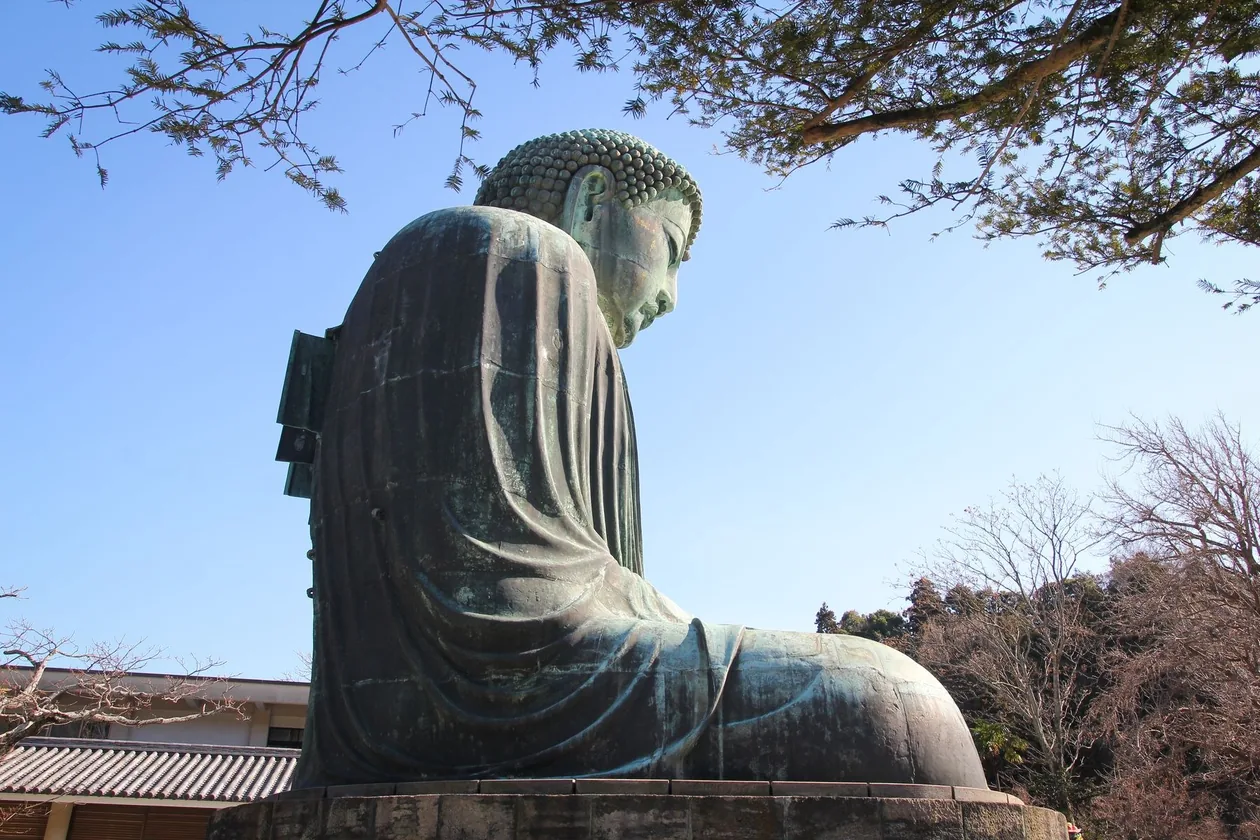
The Great Buddha of Kamakura costs ¥300 to stand in front of. For ¥50 more you can walk inside it, which almost nobody does, and see the seams where it was cast in sections in 1252. That is about thirty euro cents to get into a 13th-century bronze.
Hold that number, because it tells you something about this day trip that the tour listings do not.
In 3 minutes:
- Tokyo to Kamakura is just under an hour and ¥1,040 on the JR Yokosuka Line.
- The Enoshima Kamakura Free Pass is ¥1,640 and covers the round trip from Shinjuku plus unlimited rides on the Enoden coastal tram.
- The best-rated bus tour is about €43. The same day by train comes to roughly €13.
How do you get to Kamakura from Tokyo?
Two sensible routes. The JR Yokosuka Line runs from Tokyo Station in just under an hour for ¥1,040, and the Shonan-Shinjuku Line does the same from Shinjuku for the same fare, though only the trains bound for Zushi go direct and the rest change at Ofuna.
The alternative is the Enoshima Kamakura Free Pass at ¥1,640. It covers the round trip from Shinjuku on the Odakyu line plus unlimited travel on the Enoden, the little tram that runs from Kamakura along the coast to Enoshima and Fujisawa. The journey out takes nearly twice as long as the JR route, and for most people that is a fair trade, because the Enoden is how you move between the temples and the sea all day.
That pass is also why the arithmetic on this trip is unusual. Add ¥300 at the Great Buddha and a few hundred more at one or two temples, and a full day out of Tokyo comes to somewhere near ¥2,400.
Where to book
Our take: If you are comfortable reading a train map, buy the pass and go alone for about a third of the price; the bus is worth it when you want four sites plus Enoshima handled in one day with somebody explaining them.
Is a Kamakura tour worth it?
Be honest with yourself about what you are buying. The best-rated option runs 9 to 9.5 hours from Ikebukuro or Shinjuku, covers Tsurugaoka Hachimangu, Komachi Street, Hase-dera, Kotoku-in and Enoshima, and includes the entrance tickets at the two temples. It sits at 4.5 stars across more than 1,600 reviews and the operator has been on the platform over a decade. It is a good tour.
It is also roughly three times what the day costs on your own, and Kamakura is the one destination near Tokyo where that gap is hard to justify on convenience alone. The sites cluster tightly, the Enoden connects them, and the signage is in English.
Where the bus genuinely earns its money is Enoshima. Adding the island to a self-guided day means a tram ride, a bridge, a hill and a set of separate entry fees, and by then most people are tired. If Enoshima matters to you, let someone else drive.
One caveat from the reviews. Travellers repeatedly ask for deeper commentary at the stops, and the schedule gives Kotoku-in only 30 minutes, which is thin for the site most of them came for.
What to actually see
Kotoku-in and the Great Buddha first, because the light is better in the morning and the ¥50 interior is a five-minute queue at nine and a twenty-minute one by noon. It is 11.4 metres of bronze, open to the sky since a tsunami took the hall away in the 15th century, and it has no closing days.
Then use the Enoden instead of a taxi between stops, because the tram is half the reason to be here. It runs single-carriage through back gardens and level crossings before it breaks out along the seafront, and the stretch past Kamakura-Kokomae is the one people film. With the Free Pass you ride it as often as you like, which turns the transport into part of the day instead of the gap between temples.
Hase-dera sits a few minutes' walk downhill, with an eleven-headed Kannon over nine metres tall, a view across Sagami Bay, and rows of small Jizo statues that tend to stay with people longer than the Buddha does.
Tsurugaoka Hachimangu anchors the other end of town, at the top of Komachi Street and its couple of hundred shops. If you have an hour left and want the version of Kamakura that the bus tours skip, take it to Hokokuji instead, a small Zen temple with a bamboo grove and a tea house at the back where you can sit with a bowl of matcha and hear the stalks knock together.
What most visitors get wrong
They come for the Buddha and leave without going inside it. The doorway is on the right of the statue, the fee is ¥50, and the queue moves. It is the single best value in Kamakura and it is easy to walk past.
They also do Kamakura and Enoshima on the same self-guided day and end up rushing both. Pick one to do properly. Kamakura's temples reward slowness, and Enoshima is a hill you climb in the heat with a tower and a cave at the top.
And they compare it to the wrong alternative. Kamakura is not competing with a museum morning in Tokyo, it is competing with Nikko and Hakone for your one free day. It wins on travel time, loses on drama, and is the only one of the three you can do on a whim because nothing needs booking ahead.
- Getting there
- JR Yokosuka Line from Tokyo Station, just under 1 hour, ¥1,040 · Shonan-Shinjuku Line from Shinjuku, about 1 hour, ¥1,040
- Pass
- Enoshima Kamakura Free Pass ¥1,640: round trip from Shinjuku on Odakyu plus unlimited Enoden
- Great Buddha (Kotoku-in)
- ¥300, plus ¥50 to enter the statue · 8:00–17:30, until 17:00 October to March, last entry 15 min before · no closing days
- Getting around
- The Enoden tram links Kamakura, Hase, Enoshima and Fujisawa along the coast
- Guided option
- From €43, 9–9.5 hours, four sites plus Enoshima, Hase-dera and Kotoku-in tickets included
- Time needed
- A full day. Half a day covers the Great Buddha and Hase-dera only
Fares and temple admissions change. Confirm on the official sites before you travel.
Last verified: July 2026
Frequently asked questions
How do you get from Tokyo to Kamakura?
The JR Yokosuka Line from Tokyo Station takes just under an hour and costs ¥1,040. From Shinjuku the Shonan-Shinjuku Line takes about the same, also ¥1,040, though only trains bound for Zushi run direct. There is also the Enoshima Kamakura Free Pass at ¥1,640, which covers the round trip from Shinjuku on Odakyu plus unlimited Enoden rides, at the cost of a slower journey.
Is a Kamakura tour worth it?
It depends on whether you want to navigate. The best-rated bus tour is around €43 and covers four sites plus Enoshima with temple tickets included. Doing the same by train costs roughly €13 all in, using the ¥1,640 pass and paying ¥300 to ¥400 per temple. Take the tour for the guide and the lack of planning, not because it saves money.
How much is the Great Buddha in Kamakura?
¥300 to enter the grounds at Kotoku-in, plus ¥50 if you want to go inside the statue itself. It opens 8:00 to 17:30, or until 17:00 from October to March, with last admission 15 minutes before closing, and it has no closing days.
Can you go inside the Great Buddha?
Yes. For an extra ¥50 you can step into the hollow bronze and see how it was cast in sections in 1252. It is a small doorway and a short visit, and it is the cheapest thing you will do all day.
Kamakura or Nikko for a day trip from Tokyo?
Kamakura, if you have one free day. It is about an hour each way against roughly two for Nikko, the sites cluster within walking and tram distance, and you can add the Enoshima coast without a second trip. Nikko rewards you with Toshogu but spends four hours of your day on trains.
If you are still weighing this against the other routes, the comparison of all four day trips sorts it by travel time. Go on a weekday if you can, start at Kotoku-in before nine, and carry ¥50 in coins. The rest of the day sorts itself out.
- Best Day Trips from Tokyo: 4 Routes and How to Choose (2026)
- Hakone Day Trip from Tokyo: The Free Pass, the Art, and the Loop (2026)
- Mount Fuji Day Trip from Tokyo: Where to Actually See It (2026)
- Ghibli Museum Tickets: How to Actually Get One in 2026