Archaeological Sites in Athens: A Traveler's Guide to Ancient Ruins
Athens abolished its combined ticket in April 2025. Seeing the same seven ancient sites now costs €105 instead of €30. Here is what each one charges in 2026, which are worth it, and which you can see for nothing through a fence.
The single most important thing to know about visiting ancient Athens in 2026 is that the ticket everyone still recommends no longer exists. The €30 combined ticket, seven archaeological sites, five days, was abolished on 1 April 2025 as part of a national ticketing reform. Greece kept joint tickets for Ancient Olympia, Delphi, Mycenae and Aigai. Athens was not on the list.
Buying those same seven sites individually now costs around €105. A realistic five-site itinerary runs €90. For two people that is €180 in admissions before you have set foot in a museum.
A very large part of the English-language web has not caught up. Pages with 2026 in the title still quote the abolished combo and pre-2025 prices. This guide works from the current official sources and flags what could not be confirmed.
What the abolition actually costs
| Site | 2026 adult |
|---|---|
| Acropolis (slopes included) | €30 |
| Ancient Agora | €20 |
| Temple of Olympian Zeus | €20 |
| Roman Agora | €10 |
| Hadrian's Library | €10 |
| Kerameikos (currently closed) | €10 |
| Aristotle's Lyceum | €5 |
| All seven | €105 |
Old combined ticket for the same seven: €30. Difference: €75.
A note on those figures. The Acropolis and Acropolis Museum prices come straight from the official portals. The mid-tier and lower-tier prices follow the Ministry's five-band system (€30, €20, €15, €10, €5) and are consistent across current sources, but Greece publishes them in a spreadsheet rather than on a per-site page, so confirm at the checkout screen before you plan around them.
Buy from tickets.hh.gr, the official state platform. It is run by ODAP, a public body, and it adds no booking fee. Every other seller adds markup. Tickets are non-refundable, single entry only, and you can change the date or time up to 2 hours before your visit, a maximum of twice per ticket.
Third-party "combo tickets" are repackaged individual tickets. One widely sold bundle covering six sites for about €98 saves roughly €2 against buying them yourself, and includes Kerameikos, which is closed.
The sites, ranked by whether the money is well spent
Common rules across all state sites: winter season runs 1 November to 31 March, summer 1 April to 31 October, last admission is 20 minutes before closing, and everything shuts on 1 January, 25 March, 1 May, Orthodox Easter Sunday and 25 to 26 December.
Acropolis of Athens: €30, and non-negotiable
Metro Akropoli (L2) · Winter 08:00 to 17:00 · Summer opens 08:00, closes between 18:00 and 20:00 depending on the date · 90 minutes on the rock, 2.5 to 3 hours with the slopes
€30 adult, €15 reduced, the same price in February as in August. The old winter half-price was scrapped in 2025.
The ticket includes the south slope: the Theatre of Dionysus, the Stoa of Eumenes, the Asklepieion and the exterior of the Odeon of Herodes Atticus. The south-east gate on Mitsaion is a full entrance, not a lesser one, and it absorbs a fraction of the traffic that hits the main west gate once the coach groups arrive around 09:00. Same ticket, same slot, much shorter queue.
There is no shade on the rock and the marble underfoot is polished smooth by two and a half million pairs of shoes a year. Closed shoes with rubber soles, and more water than you think you need. No food is sold on site.
Ancient Agora: €20, and the best value in Athens
Metro Thissio (L1) or Monastiraki (L1/L3) · Summer 08:00 to 20:00, winter 08:00 to 17:00 · 90 minutes minimum, 2.5 hours with the museum
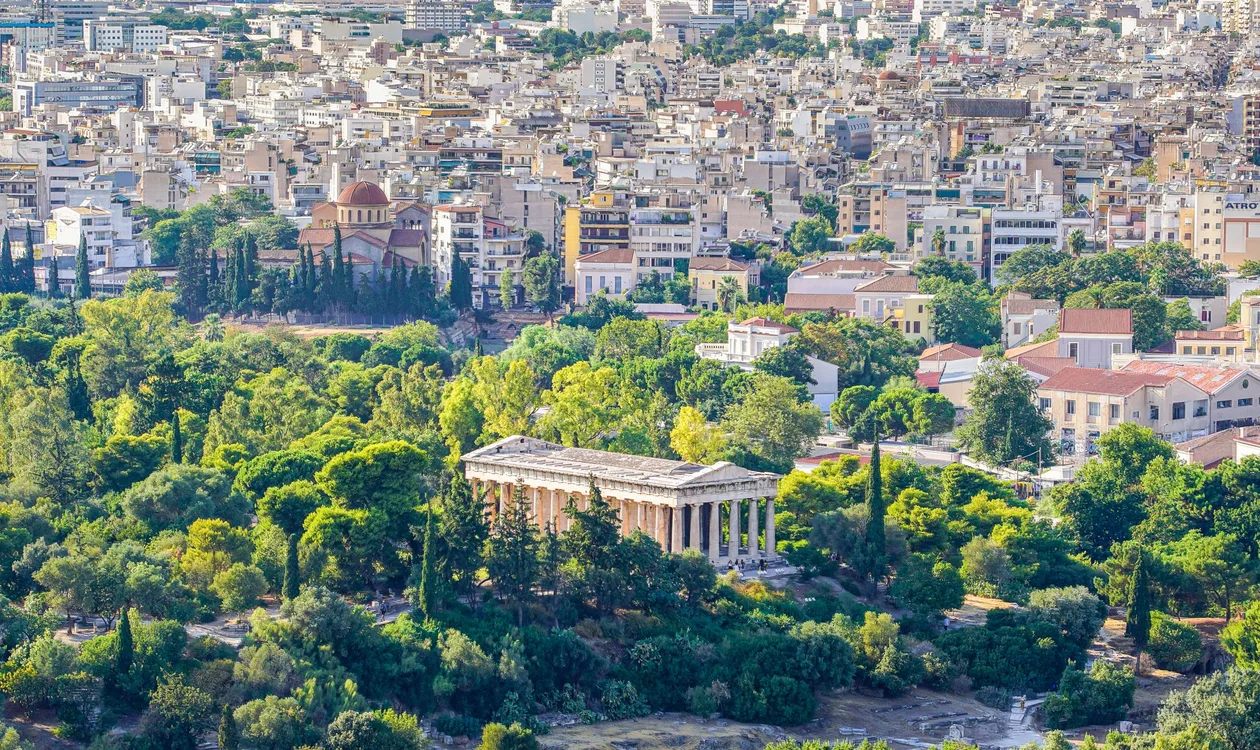
If you only add one site to the Acropolis, add this one. The Temple of Hephaistos is the best-preserved ancient Greek temple in existence, roof and colonnade intact, and unlike the Parthenon you can walk up and stand under it. That contrast alone justifies the ticket.
The Stoa of Attalos is a full 1950s reconstruction housing the site museum, including the ostraka, the potsherd ballots Athenians scratched names onto to exile each other. Themistocles' name is on several of them.
A €7.5m upgrade funded by the EU recovery facility has been running here and at Kerameikos, with new paths and better exposure of the Panathenaic Way. In March 2026 the Culture Minister described the works as in the final stretch with completion targeted for summer 2026. The Adrianou Street entrance was reported closed during the works; use the Apostolou Pavlou gate near Thissio.
Roman Agora: €10, and one very good reason
Metro Monastiraki, 220 m · Summer 08:00 to 20:00, winter 08:00 to 17:00 · 30 to 40 minutes
The reason is the Tower of the Winds, a first-century BC octagonal horologion standing essentially intact to its full height, with all eight carved wind-god reliefs in place. It housed a water clock and a weather vane, and there is nothing else quite like it surviving anywhere.
The rest of the enclosure is a gravel rectangle with the Gate of Athena Archegetis and a seventeenth-century Ottoman mosque. You can see perhaps 60% of it from the railings on Aiolou and Pelopida for free. Decide on that basis: if you have two days in Athens, skip it; if you have four, the Tower is worth €10.
Temple of Olympian Zeus: €20, and the weakest value in the city
Metro Akropoli (L2), 3 minutes · Summer 08:00 to sunset, winter reported 08:00 to 15:00 · 25 to 35 minutes
Fifteen of the original 104 columns are still standing. A sixteenth lies where a storm knocked it down in 1852 and has never been moved.
Every one of those columns is fully visible from the perimeter fence on Vasilissis Olgas, and from Hadrian's Arch, which stands outside the fence and costs nothing. The price went from €8 to €20 in 2025, a 150% rise for a site where thirty minutes is generous and the best photograph is taken from the pavement.
If your budget is finite, this is the one to drop.
Hadrian's Library: €10, mostly visible from the street
Metro Monastiraki, 2 minutes · Summer 08:00 to 19:00 or 20:00, winter reported 08:30 to 15:00 · 25 to 40 minutes
What survives and matters is the west façade wall on Areos Street, with its row of Corinthian columns. You can see that wall in full from the free pavement outside. Inside you get foundation-level remains and the footprint of a later Christian church.
Note the shorter winter hours here: the reported 15:00 close is earlier than most Athens sites, so confirm on the day.
Kerameikos: €10 when it reopens, and check before you go
Metro Kerameikos (L3) or Thissio (L1) · Status: closed
The Ephorate of Antiquities of Athens closed both the site and its museum on Monday 5 May 2025 "till further announcement" for the accessibility and infrastructure upgrade. Reporting in March 2026 targeted summer 2026 for reopening; one June 2026 source said July. We could not confirm that it has actually reopened as of August 2026. Check the Ephorate notice before making the trip.
It is worth the wait. Kerameikos is the most atmospheric site in Athens: grave stelai standing where they were erected, the Dipylon and Sacred Gates, tortoises in the long grass, and almost nobody there. The rebuild adds a new entrance, a café and step-free routes, so it will be a materially different site from the one described in older guides.
Aristotle's Lyceum: €5, and honest about what it is
Metro Evangelismos (L3), 5 minutes · Rigillis 11 · Reported closed Mondays, which is unusual for Athens · 20 to 30 minutes
Low foundation walls of a palaestra and bath complex, in a quiet garden. Nothing stands. You come because Aristotle taught here, not because there is architecture to look at.
At €5 it is the only Athens site where the price honestly matches what is on the ground. It is also empty and shaded, four minutes from the Byzantine Museum, and a reasonable place to sit down in August.
Panathenaic Stadium: €12, and run by someone else entirely
Metro Akropoli, Syntagma or Evangelismos; tram to Zappeio · March to October 08:00 to 19:00, November to February 08:00 to 17:00
The stadium is operated by the Hellenic Olympic Committee, not the Ministry of Culture. It was never on the combined ticket, it is not on tickets.hh.gr, and the ministry free days do not apply to it. €12 adult, €6 student, free under 6.
The €12 includes an audio guide in eleven languages and access to the vaulted athletes' passage and the Olympic Games exhibition. One warning for summer visitors: access to the running track is restricted from 26 June to 31 August 2026, which removes the main reason most people come. The exterior view from Vasileos Konstantinou is free and, if the track is closed, close to sufficient.
Restrooms cost €1.50, which is the sort of detail that is better to know in advance.
Acropolis Museum: €20, a museum rather than a site
Metro Akropoli (L2) · Summer Mon 09:00 to 17:00, Tue to Sun 09:00 to 20:00, Fri to 22:00 · Winter Mon to Thu 09:00 to 17:00, Fri to 22:00, Sat to Sun to 20:00 · 2 to 2.5 hours
€20 adult, €10 reduced. The museum is a separate legal entity that sets its own prices, which is why it was never on the archaeological combo and why the widely circulated "€15 summer, €10 winter" figures are out of date.
Go on a Friday evening. It is the only long night of the week, the Parthenon Gallery empties after 20:00, and the restaurant terrace looks straight at the floodlit rock. The gallery reassembles the frieze at original orientation and scale, leaving the gaps visible where the Elgin marbles are missing, which is an argument made in architecture rather than in wall text.
Booking the Acropolis in 2026
Timed entry is compulsory, year-round. You choose a slot when you buy. The official store publishes no arrival tolerance either side of it, so plan to be at the gate when your window opens; you can move the booking online up to 2 hours before, a maximum of twice per ticket, but it is non-refundable. The ticket is single entry: step outside for lunch and it is finished.
Slot lengths are not consistent. The booking interface currently shows blocks of 08:00 to 10:00, 10:00 to 12:00, 12:00 to 14:00 and 14:00 to 17:00, while several guides describe hourly intervals. Check the exact windows at the point of purchase rather than planning around a figure you read somewhere.
The daily cap is 20,000 visitors, trialled from September 2023 and permanent since 1 April 2024. The published hourly quotas start at 3,000 for 08:00 to 09:00 and 2,000 for 09:00 to 10:00, tapering after that. Before the cap the site was taking around four million visitors a year and hitting 23,000 on peak summer days, which is why the limit bites in August and is invisible in February.
The 08:00 slot sells out first, then late afternoon. Mid-day slots are the last to go, precisely because they are the ones you least want. There is no official figure for lead times; the workable rule is two weeks ahead for July and August, a week for spring and September, and walk-up in winter.
And if you have €5,000, the Acropolis sells private visits outside public hours: up to five people, at 07:00 or 20:00, on Tuesdays, Fridays and Saturdays, with up to four such groups on the rock at once. That works out at €1,000 a head against €30 general admission.
Heat is now a scheduling variable
The Acropolis has closed during heatwaves in each of the last three summers. On 8 July 2025 it stayed shut until 17:00, the Ministry citing the safety of workers and visitors, while the labour ministry imposed a national 12:00 to 17:00 outdoor work pause. The same happened on 13 June 2024 at 43°C.
The closure window consistently runs from around midday to 17:00 and tracks the labour rule rather than a site-specific threshold. Greece does not publish a temperature trigger, and closures are typically announced only the day before.
The planning consequence is simple. In July and August, book 08:00. A midday closure destroys a 12:00 or 14:00 slot and leaves you arguing about a refund with a platform whose tickets are non-refundable except for force majeure. It cannot touch an 08:00 slot.
When Athens sites are free
The Ministry publishes a fixed list: 6 March, 18 April, 18 May, the last weekend of September, 28 October, and every first and third Sunday from 1 November to 31 March.
Note the "and third". The winter free Sundays were doubled in the 2025 reform and a great many guides still say first Sunday only. Remaining free dates in 2026: 26 and 27 September, 28 October, then 1 and 15 November, 6 and 20 December.
There is also the August Full Moon, which almost no guidebook mentions. On Friday 28 August 2026, 126 archaeological sites, monuments and museums across Greece open free of charge into the evening, typically from 19:30 or 20:00 until 23:00 or midnight, with satellite events on 26, 27, 29 and 30 August. It has run for 27 years. Confirm which Athens sites are on the 2026 programme before building an evening around it.
Free year-round: EU citizens under 25 with ID, non-EU visitors under 18 with a passport, EU and EEA students of any age with an attendance certificate, people with disabilities of 67% or more plus one companion, refugees, ICOM and ICOMOS members, licensed guides and accredited journalists.
Half price: Greek and EU pensioners over 65, but only from October to May. The 2025 reform removed the summer senior discount, so a 70-year-old visiting in August pays the full €30.
One practical caveat. Free days at the Acropolis are heavily oversubscribed and still require a booked slot. Free does not mean walk up.
A workable two-day plan
Day one, morning. Acropolis at 08:00 through the Mitsaion gate. Down the south slope. Acropolis Museum from around 11:00, or save it for Friday evening. €50.
Day one, late afternoon. Ancient Agora from 17:00, when the light is low and the temple is at its best. €20.
Day two. Roman Agora and the Tower of the Winds, then walk to Hadrian's Library and look at the façade from Areos Street without paying. Hadrian's Arch and the Olympieion columns from outside the fence. Panathenaic Stadium if the track is open. €22 to €32.
Total for two days: €90 to €100 a person. Under the old combined ticket the same itinerary was €30 plus the museum. That is the honest state of things in 2026.
Where to book
Our take: if you only want entry, buy direct at tickets.hh.gr for €30 with no fee, and take the 08:00 slot. A guided tour is worth the difference on the Acropolis specifically, where the ruins give up very little without someone explaining what was where. For every other site on this page, buy the plain ticket and read the signs.
Practical info
- Acropolis
- €30 adult year-round · €15 reduced for EU citizens over 65, 1 Oct to 31 May only
- Combined ticket
- Abolished 1 April 2025
- Seasons
- Summer 1 Apr to 31 Oct · Winter 1 Nov to 31 Mar
- Last admission
- 20 minutes before closing at all state sites
- Book on
- tickets.hh.gr (official, no fee) · GetYourGuide for guided tours
Kerameikos was still closed for works at the time of writing. Greek site prices below the top tier are published in a ministry spreadsheet rather than per site; confirm at checkout.
Last verified: August 2026
If the Acropolis is your priority, our Acropolis tickets guide goes deeper on slots, entrances and what to see once you are up there, and Acropolis vs Acropolis Museum settles the question of doing one, the other or both. For the museum ticket itself, see our Acropolis Museum guide. If your interest is the objects rather than the ruins, the National Archaeological Museum holds most of what came off these sites, and our 7 best museums in Athens ranks the rest.
Frequently asked questions
Is there still a combined ticket for Athens archaeological sites?
No. The €30 combined ticket covering seven sites for five days was abolished on 1 April 2025 as part of a national ticketing reform. Greece kept joint tickets only for Ancient Olympia, Delphi, Mycenae and Aigai. In Athens you now buy each site separately, and the same seven sites cost roughly €105.
How much does the Acropolis cost in 2026?
€30 for adults, year-round. The old 50% winter discount was scrapped in April 2025, so the November to March price is the same as August. The €15 reduced ticket is narrower than most guides say: EU citizens over 65, and only between 1 October and 31 May. Buy from tickets.hh.gr, the official state platform, which charges no booking fee.
Do I need to book an Acropolis time slot in advance?
Yes. Timed entry is compulsory year-round and the site admits a maximum of 20,000 visitors a day, with 3,000 allocated to the 08:00 to 09:00 hour. The official store publishes no arrival tolerance, so treat your slot as the deadline rather than a cushion; you can move the booking online up to 2 hours before, twice per ticket. In July and August book the earliest slot at least two weeks ahead; in winter you can usually walk up.
Which Athens archaeological sites are worth paying for?
The Acropolis and the Ancient Agora, without hesitation. The Agora holds the Temple of Hephaistos, the best-preserved ancient Greek temple anywhere, and you can walk right up to it. The Roman Agora is worth €10 for the Tower of the Winds alone. The Temple of Olympian Zeus at €20 is the weakest value in the city.
When is entry to Greek archaeological sites free?
6 March, 18 April, 18 May, the last weekend of September, 28 October, and every first and third Sunday from 1 November to 31 March. The winter free Sundays were doubled in 2025 and most guides still say first Sunday only. EU citizens under 25 and non-EU visitors under 18 enter free year-round with ID.
Does the Acropolis close in the heat?
It has closed during heatwaves in each of the last three summers, typically from around midday until 17:00, tracking the national outdoor-work ban. On 8 July 2025 it stayed shut until 17:00. Closures are usually announced only the day before, which is why an 08:00 slot is the only heat-proof booking in July and August.