National Archaeological Museum Athens Tickets 2026: €20, Hours & What to See
Greece's greatest museum holds the Mask of Agamemnon and the Antikythera Mechanism, the oldest known analog computer. Tickets are now €20 all year. Here's how to book, when to go, and what not to miss.
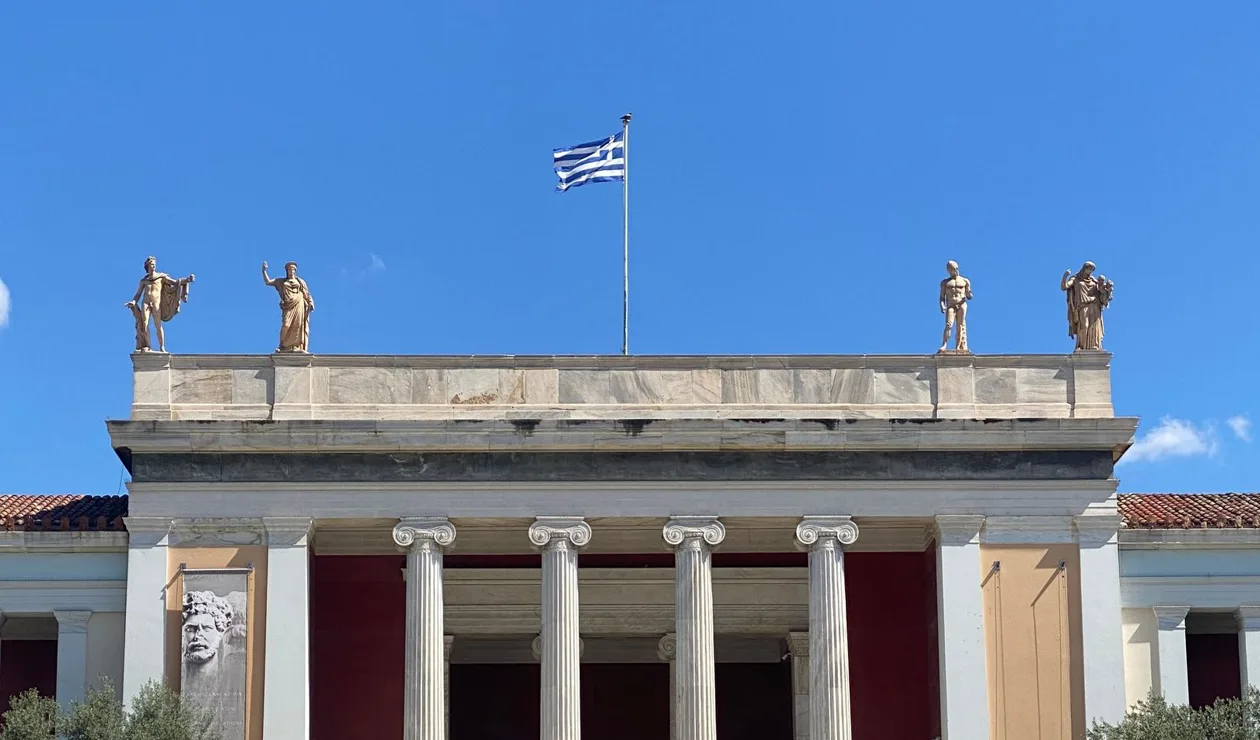
Most visitors do the Acropolis and call Athens done. They miss the building that holds the actual treasure: a 2,000-year-old bronze gear-train that predicted eclipses, the gold death mask Schliemann thought belonged to Agamemnon, and a sea-recovered Zeus frozen mid-throw. The National Archaeological Museum is the deepest collection of ancient Greek art anywhere. Tickets are now €20, the same all year.
In 3 minutes
- Price: €20 flat, summer and winter (up from €12 on January 1, 2026)
- Time needed: 1.5 hours for the highlights, 2–3 for a proper visit
- Don't miss: Mask of Agamemnon (Room 4), Antikythera Mechanism (Gallery 43), Artemision Bronze (Room 15)
Why visit, and what it costs
The Acropolis Museum shows you one hilltop. This shows you 7,000 years across all of Greece: Mycenaean gold, Cycladic marble figures, the bronzes pulled from ancient shipwrecks. It's encyclopaedic where the Acropolis Museum is focused, which is exactly why it rewards a second museum day.
The price jumped from €12 to €20 on January 1, 2026, and it no longer changes with the season. That's still less than the Acropolis site (€30), and the museum rarely sells out, so you don't need to fight for a morning slot the way you do at the Acropolis.
Where to book
Our take: Book direct at €20 — it seldom sells out, so the queue insurance isn't worth paying for. Pick GetYourGuide (about €30) only if you want the multi-language audio tour included, since the museum's own labelling is thin.
What to see in 90 minutes
Start in Room 4. The Mycenaean gold, including the Mask of Agamemnon, hammered from a single gold sheet around 1600 BC. Look at the beard and the closed eyes — the detail is finer than any photo shows, and the mask is smaller than you expect.
Walk to Room 15 for the Artemision Bronze, a god from the sea recovered off Cape Artemision. Stand to the side: arms spread, weight on one foot, about to hurl a thunderbolt (Zeus) or trident (Poseidon). Scholars still argue which.
Find Gallery 43 at the back for the Antikythera Mechanism. Recovered from a shipwreck in 1901, this corroded bronze device used dozens of gears to model the sun, moon, and planets. It's the oldest known analog computer, and nothing else like it survives for another 1,000 years.
Don't skip the Cycladic figures in the prehistoric collection — flat, white marble forms from 3000 BC that look startlingly modern and influenced Picasso and Brancusi.
What most visitors wish they knew
The Tuesday trap. The museum opens at 1 PM on Tuesdays, not in the morning. People show up at 9 AM to a closed door all year round. Every other day it opens early.
Mornings are calmest. Reviews are consistent that it's rarely crowded, but weekday mornings right after opening are emptiest. The Antikythera room and the Mycenaean gold get tour groups by late morning.
It's a real trip from the Acropolis. This isn't a Plaka stroll — the museum sits about 3 km north, near Victoria station. Don't try to walk it in summer heat. The metro takes around 16 minutes.
National Archaeological Museum or Acropolis Museum?
Different museums, not competitors. The Acropolis Museum shows what stood on the Acropolis; the NAM shows everything else, from everywhere in Greece, across 7,000 years. First-time visitors pairing a museum with the Acropolis site usually pick the Acropolis Museum. The NAM is the deeper cut for history lovers and return visitors. We lay out the full trade-off, including a same-day route, in our Acropolis Museum vs National Archaeological comparison. For the wider city, see the 7 best museums in Athens and the Acropolis Museum tickets guide.
- Tickets
- €20 all year · reduced €10 for EU visitors 65+ (Oct–May)
- Free entry
- EU under 25, non-EU under 18, EU students, ICOM · Mar 6 · Apr 18 · May 18 · last weekend of Sept · Oct 28 · 1st & 3rd Sun Nov–Mar
- Hours (summer, May 4–Nov 15)
- Wed–Mon 8 AM–8 PM · Tue 1 PM–8 PM (last admission 7:30 PM)
- Hours (winter, Nov 16–May 3)
- Wed–Mon 8:30 AM–3:30 PM · Tue 1 PM–8 PM
- Closed
- Jan 1 · Mar 25 · May 1 · Orthodox Easter Sunday · Dec 25–26
- Getting there
- 44 Patission (28is Oktovriou) St · Metro Victoria (Line 1) or Omonia (Lines 1 & 2)
- Book at
- namuseum.gr · tickets.hh.gr (official)
Hours and prices can change — confirm on the official site before you go.
Last verified: June 2026
Frequently asked questions
How much are National Archaeological Museum Athens tickets in 2026?
€20 all year, up from €12 on January 1, 2026. Reduced €10 for EU visitors over 65 (October–May). EU citizens under 25, non-EU under 18, EU students, and ICOM members are free.
When is the National Archaeological Museum free?
EU citizens under 25 are always free. Everyone is free on March 6, April 18, May 18, October 28, the last weekend of September, and the first and third Sunday from November to March.
Is the Antikythera Mechanism worth seeing?
Yes. It's a 2nd-century BC geared device that predicted eclipses, the oldest known analog computer. It has its own room (Gallery 43) at the back, and most visitors walk straight past it.
How long do you need at the National Archaeological Museum?
About 1.5 hours for the highlights, 2–3 hours for a fuller visit. The collection is large enough to overwhelm if you try to see everything.
How do you get to the National Archaeological Museum from the Acropolis?
It's about 3 km north of the Acropolis, not walkable in the heat. Metro Line 1 to Victoria (5-minute walk) or Omonia (10 minutes); about 16 minutes from the Acropolis area.
Go for the three objects that rewrite what you thought the ancient world could do: a gold mask, a bronze god, and a geared computer built 2,000 years before the next one. Give it 90 focused minutes and you'll leave understanding Greece better than the Acropolis alone can teach.
Last verified: June 2026