The Big Room Is the Front Door.
A 75-minute route through Palazzo Vecchio: the Salone as a starting point, the door most people miss, the second floor in the order the Medici used it, and the Map Room last.
Get your free guide
Enter your email to unlock the full room-by-room guide. One email unlocks all Florence museum guides.
Free · No spam · Unsubscribe anytime
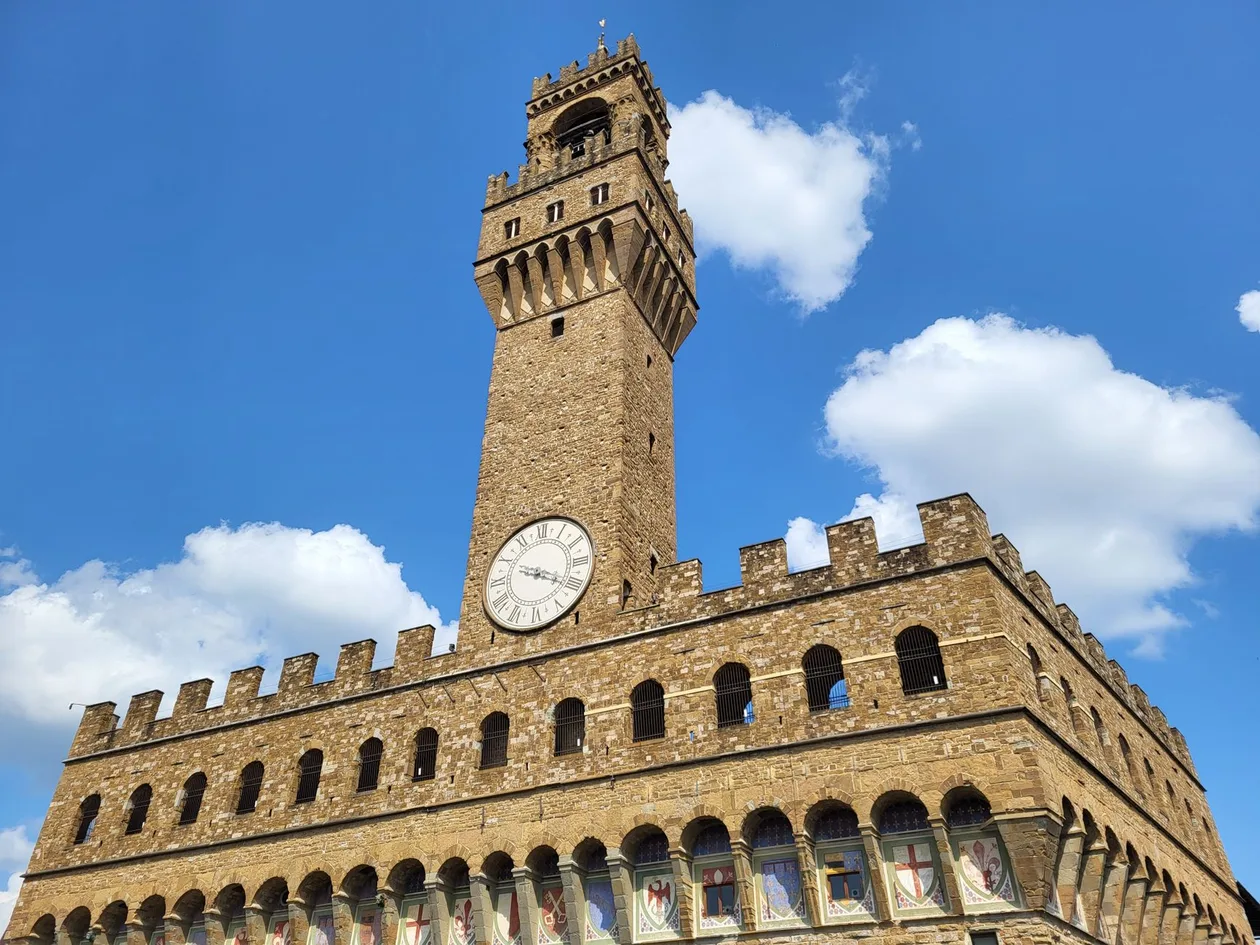
The Salone dei Cinquecento was built to stop you in your tracks, and it works: most visitors spend half their time in it and ten minutes on everything else. Reverse the ratio. Give the hall fifteen minutes and its side door twenty, then climb to the rooms the palace was painted for.
Michelozzo's courtyard is free and always full; do not linger. Climb to the Salone dei Cinquecento and walk straight to the south end before you look at anything, so that Michelangelo's Genius of Victory is at your back and the whole 52-metre hall opens in front of you. Then turn to the east wall and find the green banner reading cerca trova in Vasari's battle of Marciano.
Off the Salone, near the entrance you came in by, is a small door into the Studiolo of Francesco I: a windowless cabinet painted between 1570 and 1575, every cupboard front a picture of what was kept behind it. It is the best room in the building. Access varies by day and by tour, and MUS.E's Secret Passages visit is built around it; if the door is shut, this is the one reason to add that tour.
Take the stairs to the monumental apartments and keep moving through the quarters of Leo X, which are about the family, into the quarters of the Elements, which are about the universe, and then into Eleonora of Toledo's rooms. Stop in her chapel for Bronzino's Crossing of the Red Sea, painted in the early 1540s for a duchess from Spain who had just arrived in a city that did not want her.
Finish in the two rooms the tour groups reach when they are already tired. The Sala dei Gigli has Ghirlandaio's frescoes of 1482 and Donatello's Judith and Holofernes, moved here for protection from the square in 1988. Next door, the Hall of Maps: 53 painted maps by Egnazio Danti and his successor around a globe, the world as the Medici wanted it filed. Look for the corridor with the plaster face said to be Dante's death mask on the way.
Every other day runs to 19:00, with sales stopping an hour before. Thursday afternoon arrivals are the most common complaint in reviews, and the tower shuts at 14:00 that day too.
€20 plus €1 online, its own slot, mandatory booking, closed in rain or heat alert, no children under 6, and 418 steps from the ground by the official count (223 inside the tower). Put the slot after the museum, not before, and read the ticketing site's notice box the morning you go.
TripAdvisor reviewers praise the frescoes and complain about the lack of labels in the same sentence. The third-party ticket's audio runs on your own phone, so bring headphones; if you book official, download a guide before you enter.
The Roman theatre under the palace is a separate guided visit on Saturdays and Sundays at 12:00 and 12:45, €5, fifteen people at a time. Book it with the museum ticket on the official site; it is not sold on the third-party listings.
Why it matters: Carved for the tomb of Julius II and never installed there. It went to the Bargello in 1868 and came back in 1921, which is why it is the one Michelangelo in Florence you see without a queue.
What to notice: The old man crushed underneath has Michelangelo's own beard. Walk round to the side: the group is a spiral, and it was designed to be read from below in a niche, not head-on.
Why it matters: One of six battle scenes that turned a republican council hall into a Medici victory parade. This one carries a small green flag lettered cerca trova, seek and you shall find, which has fed four decades of argument about whether Leonardo's lost Battle of Anghiari survives behind it.
What to notice: Stand at the centre of the hall and find the flag high in the fresco; it is legible without binoculars once you know where to look. Then look at the ceiling: 39 panels, and Cosimo I in the middle, crowned by Florence.
Why it matters: The bronze that stood in Piazza della Signoria as a republican warning before David did, brought indoors in 1988. A copy holds its place outside.
What to notice: Walk all the way round. Donatello cast it to be seen from every side, and the three reliefs on the base tell their own story; then compare the violence here with the calm Ghirlandaio saints on the wall behind, painted twenty years later.
How well did you look?
3 quick questions about what you just saw
Visit complete!
Share your visit or save it for later
Your collection