An Empty Building Is the Point.
A 90-minute route through the Baths of Caracalla — the axis in the order that makes the plan legible, the two mosaic floors still in place, and the rooms that only open after dark.
Get your free guide
Enter your email to unlock the full room-by-room guide. One email unlocks all Rome museum guides.
Free · No spam · Unsubscribe anytime
Everyone walks in through the north gate and straight down the middle, which is the order the service staff used. Bathers came the other way. Walk it backwards and the building explains itself.
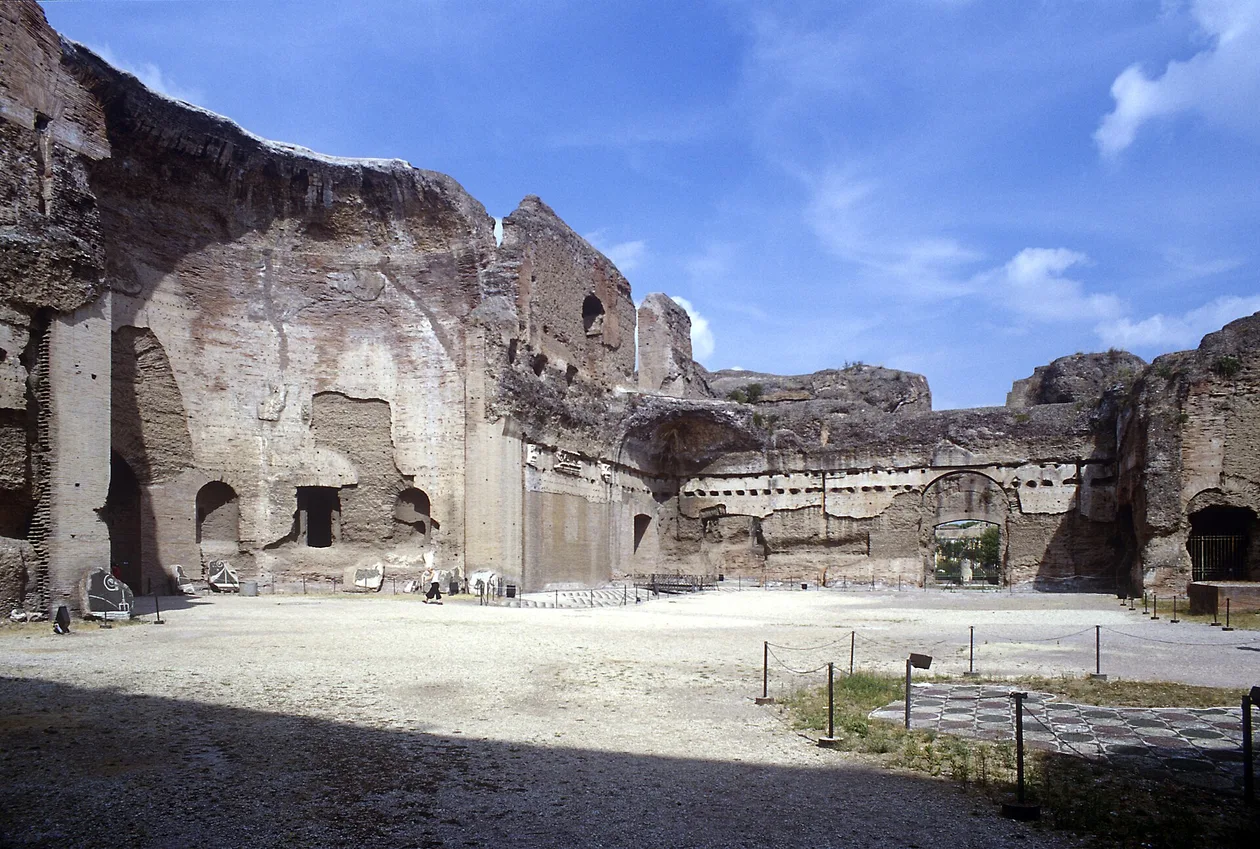
Resist the pull towards the big walls for a quarter of an hour. The rectangle you are standing in is not the baths, it is the park that surrounded them: cisterns along the back, two libraries in the exedrae on the east and west, latrines on the flanks. The Romans came here to walk, read and talk as much as to wash, and the Soprintendenza's own description of the site puts strolling, meditation and study in this outer ring. Get the scale of the enclosure into your head first and the central block stops looking like a random field of brick.
Go to the north-west side and find the wall of the natatio, the open-air pool, which still carries two orders of niches that once held statues. This is the most useful wall on the site: it is the only place where you can see, without a reconstruction drawing, how high the building went. Then step south into the frigidarium, the cold hall, and look up at the springing of the vaults. The roof is gone but the scars where it landed are not.
Keep walking south along the single axis. Tepidarium, then calidarium, the round hot room at the end, which is the mass you can see from Viale delle Terme di Caracalla before you buy a ticket. Under your feet, and under everything you have walked so far, run about two kilometres of service galleries: furnaces, boilers, water plant, a mill, wood stores. You are not going down there on a day ticket, but knowing the machine is under the floor changes what the floor is.
Turn east into the palaestra, one of the two exercise courts, and look down: patches of black-and-white geometric paving survive in place, and most visitors cross them without noticing they are Roman. From here the Domus di Vigna Guidi, a house that predates the baths, is on the ordinary ticket and holds the painted shrine restored in 2022. Finish at the Reflecting Pool, the contemporary installation in the shape of the ancient natatio that put water back into the complex after roughly 1,800 years.
Not reduced hours, closed. The Soprintendenza's calendar shows Monday shut in all five seasonal bands of the year.
The official page states that additional services such as guided visits and fast-track are not offered here. Anything sold as a skip-the-line Caracalla ticket is a margin on a queue that does not exist.
The service galleries and the Mithraeum open on a handful of announced evenings a year, self-guided, 1,200 places a night. In 2026: 16 and 23 July, 2 August, 19 and 26 September, 15 October.
On the busiest days, the free first Sunday included, the Domus di Vigna Guidi frescoes close for conservation. An €8 Tuesday gets you more of the site than a free Sunday does.
Free app from the Soprintendenza and the Italian Space Agency, launched August 2026. It drops the Farnese Hercules and Farnese Bull back into their original rooms in augmented reality, and there is no wifi at the gate.
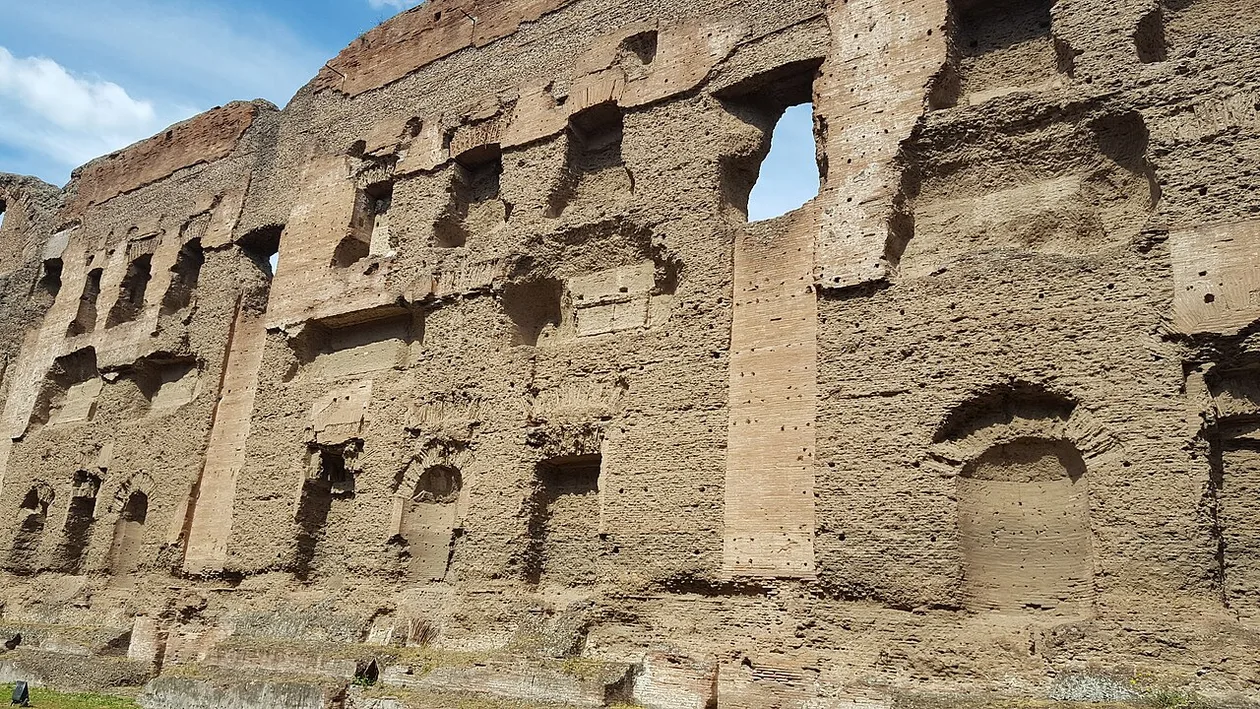
Why it matters: The pool itself is gone, but the wall behind it survives with two superimposed rows of niches for statues. It is the tallest readable elevation on the site and the only one that gives you the vertical dimension of the building.
What to notice: Count the two orders, then imagine a statue in each niche and coloured marble on every flat surface between them. The sources describe columns, oriental marble floors, glass-paste wall mosaics and hundreds of statues. What you are looking at is the plaster-and-brick backing that was never meant to be seen.
Why it matters: A house that stood here before the baths were built over it, excavated from 1858 and reinstalled in the visit route after a restoration completed in 2022. It is the only place on the site where you see painted decoration rather than structure.
What to notice: The shrine puts Anubis and Isis, with a third figure read as Osiris, directly opposite Jupiter, Juno and Minerva. Egyptian gods facing the Capitoline triad in one room is rare enough that the Soprintendenza calls it a unicum. Check before you go: it shuts on the most crowded days.
Why it matters: A water mirror laid into the shape of the ancient pool. Rome's city tourism office describes it as restoring the element the whole complex was built around, absent for roughly 1,800 years, and as a working stage for concerts and performances.
What to notice: Stand at the short end and use the reflection to double the height of the ruin behind it. It is the one spot on the site where a phone photograph gets close to the scale your eyes are reporting.
How well did you look?
3 quick questions about what you just saw
Visit complete!
Share your visit or save it for later
Your collection