A Private Road Across the River.
A 45-minute route through the Vasari Corridor: where to slow down, which windows to stop at, the balcony into Santa Felicita, and how to walk out into Boboli with a plan.
Get your free guide
Enter your email to unlock the full room-by-room guide. One email unlocks all Florence museum guides.
Free · No spam · Unsubscribe anytime
The corridor was built so that nobody would see the Medici cross the river. Everything in it points outward: the windows, the balcony, the bend around a tower they could not buy. Walk it looking out, not along.
The self-portraits that used to line the corridor now hang in new rooms on the Uffizi's first floor, and they are included in the ticket you already have. Put them at the end of your two hours in the gallery, just before your corridor slot, so the faces are fresh when you step into the empty walls.
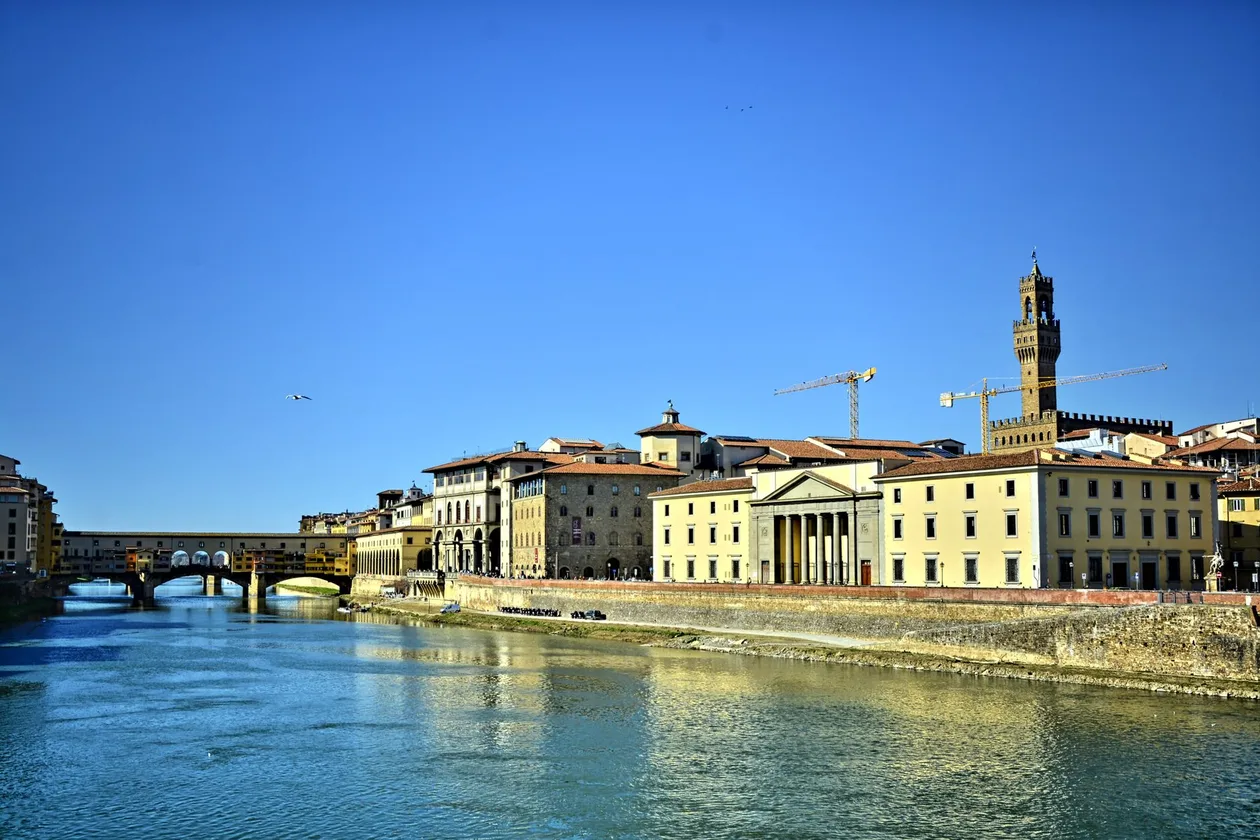
The group leaves the gallery and drops towards the Arno along the river front. Stay on the river side of the group on the first stretch, where the windows face the water and the Ponte Vecchio ahead of you. Two museum staff set the pace, so where you stand is the only thing you control.
Over the bridge the walls fill with more than fifty Roman portrait busts, installed on 7 July 2025 from the Uffizi's stores. Halfway across, the three larger openings look straight up and down the Arno. The story that they were cut for Hitler in 1938 is a legend; they date from 1860, opened so the king could watch the San Giovanni fireworks. This is where to stop.
Just past the bridge the corridor swings around the Mannelli tower on stone brackets, because the family refused to sell. Then a railing opens onto a balcony inside the church of Santa Felicita: the Medici followed Mass from here without going down into the nave. You leave through a door by the Buontalenti Grotto in the Boboli Garden, and there is no way back.
Your corridor slot has to be at least two hours after your Uffizi slot. Book a 9:00 Uffizi entry and an 11:00 corridor slot and the whole thing is done by noon, on the right side of the river for lunch.
From 3 July to 20 November 2026 the corridor opens on Friday evenings, 19:00 to 23:00, corridor only, €24 online. You pass through the Uffizi without stopping and walk out into Piazza Pitti by the Rondò di Bacco gate.
Suitcases, backpacks, rucksacks and large umbrellas are banned, and the exit is across the river in Boboli. Leave the bag at the hotel rather than the Uffizi cloakroom, or you walk back for it.
The walls are close to bare, so a guide earns their fee here more than in most museums. If you are going for the Arno view rather than the history, go on your own and spend the time at the windows.
Why it matters: The one position in Florence from which you look along the river through the middle of the bridge. Everything else in the corridor is a passage; this is a place.
What to notice: Look upstream first, towards Ponte alle Grazie and the hills, then downstream to Ponte Santa Trinita. Downstream is west: on a Friday evening that is where the sun goes down.
Why it matters: More than fifty heads, among them Cicero, Augustus, Antoninus Pius, Commodus, and the empresses Sabina and Faustina. Bought in the eighteenth century for the Uffizi's imperial portrait series, taken off display in 1993, back in public view since July 2025.
What to notice: Find Cicero and Augustus and compare the two: one is a man, the other is a brand. The official portraits of emperors repeat the same idealised face for decades; the private citizens age.
Why it matters: A window into a working church from a private road. The Medici could follow Mass here without going down into the nave, and nothing in the corridor says more about why the whole thing was built.
What to notice: Notice how far above the nave you are and how little of the congregation could see you. The court followed the service from above and apart, which is the whole corridor in one window.
How well did you look?
3 quick questions about what you just saw
Visit complete!
Share your visit or save it for later
Your collection