A Bible in Glass
A level-by-level route through the Lower Chapel, the spiral stair, and the 15 windows of the Upper Chapel — with a reading key for the glass.
Get your free guide
Enter your email to unlock the full room-by-room guide. One email unlocks all Paris museum guides.
Free · No spam · Unsubscribe anytime
The walls have not disappeared — they were replaced by glass. Everything you are standing inside was built as a reliquary for a single object.
Enter the Lower Chapel first. It is low, dim, and painted in deep blue with gold fleur-de-lys — the opposite of what comes next. The columns alternate two symbols: the fleur-de-lys of Louis IX's father (Capet) and the castle of Castile from his mother Blanche. This is the chapel where servants and palace staff worshipped. The narrow staircase to the Upper Chapel is on the far right.
The spiral staircase is 33 steps and genuinely narrow — single file, stone walls close on both sides. When the door at the top opens, stop before you move forward. The first view of the Upper Chapel from the doorway — the full height of the glass in one frame — is the moment most visitors describe as the best. Do not rush past it.
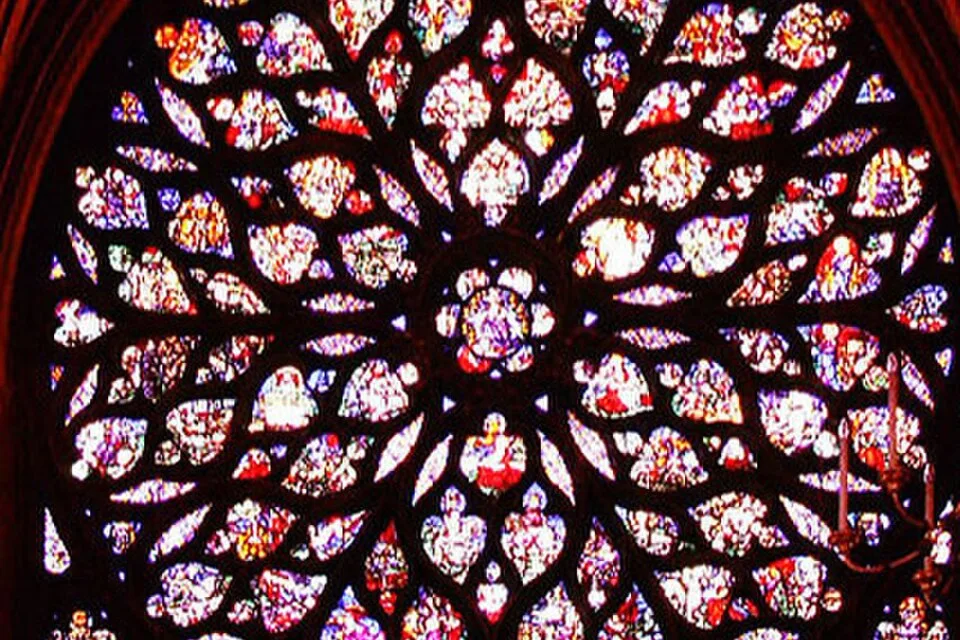
Start on the north wall (your left as you enter) at the first bay: Genesis. Read each window bottom to top, then move to the next bay clockwise. The south wall's westernmost window — the Relics window — shows Louis IX carrying the Crown of Thorns into Paris. End at the west wall: the rose window. 89 panels of the Apocalypse, installed two centuries after the other glass, cleaned in 2015. Stand far back to read the full composition.
The security check inside the Palais de Justice is airport-style and cannot be bypassed — even with pre-booked tickets. The official site advises 30 minutes on busy days. Arrive early and leave glass bottles and sharp objects at the hotel.
The rose window faces west. In the morning it is often in shadow or flat. From mid-afternoon, direct sunlight activates it fully — the Apocalypse panels read at a different intensity. If you have a choice of entry slot, afternoon on a clear day is better for the rose.
The Conciergerie is 200 metres away in the same Palais de Justice complex. The combined ticket (€30 non-EEA / €23 EEA) is cheaper than two singles. Visit one before or after the other; Conciergerie last entry is 17:15.
A guided tour of the chapel runs daily at 11:00 and 15:00 in French, at no extra charge on your ticket. Book the 10:30 or 14:30 entry slot to be inside in time. It covers the window programme and architectural structure in 45 minutes.

Why it matters: The theological centre of the entire glass programme. The chapel was built to house the Crown of Thorns; this window depicts the events that gave the crown its meaning. It occupies the prime position in the apse, flanked by the Infancy of Christ (left) and Saint John the Evangelist (right).
What to notice: Read the panels from bottom to top. The Crucifixion scene sits roughly two-thirds of the way up. Below it, the narrative builds through the Passion sequence; above it, post-Resurrection. The scale of each figure is deliberately compressed to fit more narrative into each lancet.

Why it matters: The only window in the nave depicting a contemporary living figure: Louis IX himself, barefoot and dressed as a penitent, carrying the Crown of Thorns from the Seine riverbank to the chapel after its arrival from Constantinople in 1239. He spent 135,000 livres on the relic and 40,000 on the building. This window makes that relationship visible.
What to notice: Find the panel showing two men in royal dress carrying a reliquary box on their shoulders — Louis IX is the figure on the left, his brother Robert of Artois on the right. The scene occupies the middle registers of the window. Look for the gold reliquary chest between them.

Why it matters: Made two and a half centuries after the other windows, the rose window is a deliberate contrast: Flamboyant Gothic tracery replacing the earlier Rayonnant geometry, 89 panels replacing the tall lancet format, silver-stain technique replacing the earlier pot-metal glass. Cleaned in 2014–2015, it is noticeably brighter than the 13th-century windows around it.
What to notice: Stand at the far west end of the nave and look back toward the entrance. From this position you can read the four concentric registers of the composition: the central Lamb of God, surrounded by angels and candlesticks (the Seven Churches of Revelation), then the Four Horsemen and the great tribulations, and at the outermost ring, the souls gathered for final judgement.
How well did you look?
3 quick questions about what you just saw
Visit complete!
Share your visit or save it for later
Your collection