Rothko in Florence 2026: The Show, the Two Satellites & How to See It
Palazzo Strozzi, 14 March – 23 August 2026. 70+ Rothko works, plus two satellite venues most visitors skip — five paintings inside Fra Angelico's monastery and two Seagram studies at the foot of Michelangelo's staircase.
Exhibition ended: Rothko in Florence closed on 23 August 2026. The article below is kept for reference. Palazzo Strozzi's next show is Broken. The Power of the Fragment, 25 September 2026 to 24 January 2027; the paid floor is empty until then, though the courtyard stays open and free.
In 1950, Mark Rothko walked into the Convent of San Marco in Florence and spent hours in front of Fra Angelico's frescoes — small, devotional scenes painted directly onto the walls of monks' cells, lit only by what fell through narrow windows. He left changed. Eight years later he was painting the Seagram Murals: oxblood and black panels, the size of altarpieces, scaled to a room he wanted you to feel rather than read.
That whole chain — the 1950 visit, a second trip in 1966, and the paintings that came after — is the reason Rothko in Florence existed. It ran at Palazzo Strozzi from 14 March to 23 August 2026, with two satellite installations at the exact Florentine sites that shaped him.
In 3 minutes
- 70+ works across the piano nobile, on loan from MoMA, the Met, Tate, Pompidou, and the National Gallery of Art in Washington
- Two satellite venues: five Rothkos placed inside Fra Angelico's cells at the Museo di San Marco, plus two Seagram Murals studies (1958) at the foot of the Michelangelo-designed staircase in the Biblioteca Medicea Laurenziana
- Closed on 23 August 2026. Tickets had been €15 dated or €20 open date. Next at Strozzi: Broken. The Power of the Fragment, 25 September 2026 – 24 January 2027
Why this exhibition only makes sense in Florence
Most Rothko retrospectives organise themselves around colour — early Surrealist work, the breakthrough into the floating rectangles around 1949, the darks of the late 1960s. Rothko in Florence organises itself around an argument, and the argument is that the artist's most spiritual late work — what he called the desire to evoke "basic human emotions" — was set in motion by what he saw here.
Curators Christopher Rothko (the artist's son) and Elena Geuna build the case in the choice of works. The Strozzi rooms hold the 1949 horizontal floating bands (lent by MoMA), the mid-50s expanses of plum and orange, and the darker oxblood-and-black canvases from the Seagram and Houston Chapel periods. The two satellite venues then close the loop: at Laurenziana you see the actual Seagram studies inches from Michelangelo's staircase that inspired them, and at San Marco you see Rothko's late work hung where Fra Angelico's Annunciation lives. The pairing is not academic. It is the show's point.
This exhibition is over — what to book instead
Our take: Rothko in Florence closed on 23 August 2026 and the two satellite installations closed with it. If you are in Florence now, the Strozzi courtyard is open and free but the paid floor is empty until 25 September, when Broken. The Power of the Fragment opens — our full guide covers dates, tickets and what to see. For the permanent Florence collections in the meantime, the Uffizi and the Bargello are the closer substitutes for what this show did well.
The Rothko in Florence guide — ready in 3 minutes
- The exact order: Laurenziana first (small, weekday-only), then Strozzi, then San Marco
- Which Strozzi rooms hold the Seagram-era darks — and which to sit in longest
- How to time the Thursday late-night slot when the piano nobile is half-empty
What you'll actually see at Palazzo Strozzi
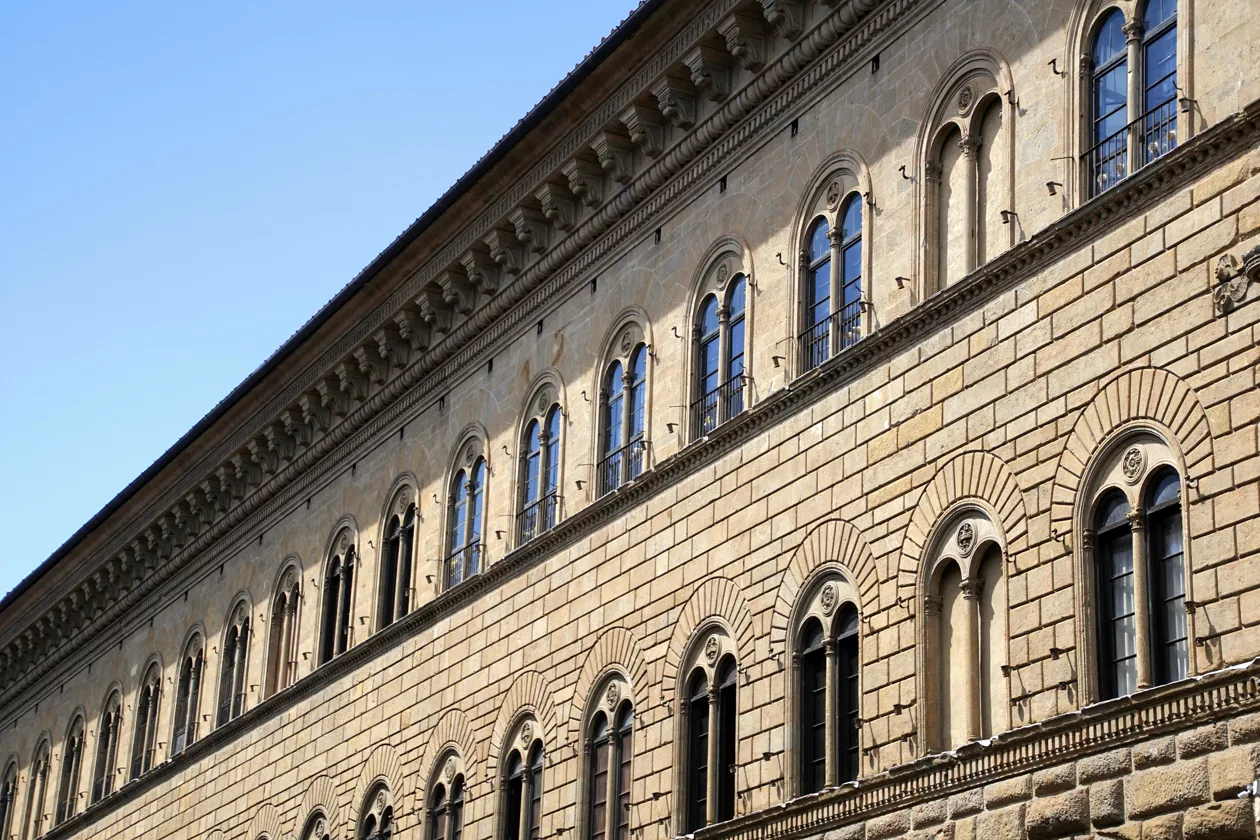
The exhibition occupies the entire piano nobile — the first floor of the Renaissance palace built between 1489 and 1538. The rooms are unusually tall and proportioned for the scale Rothko worked at. Most installations of his large canvases in modern white cubes feel cramped. These don't.
Walk in and you get the chronology straight: early figurative and Surrealist-adjacent work from the late 1930s and 1940s, then the breakthrough in 1949 — the moment Rothko abandoned representation entirely and started painting the floating rectangles that became his signature. No. 3 / No. 13 (1949), on loan from MoMA, marks the pivot.
The middle rooms hold the high-saturation period: oranges, reds, plums layered into rectangles that seem to vibrate at the edges. Stand back further than you think you need to. The colour is calibrated for distance.
The later rooms shift darker. This is where the Seagram-era and Houston Chapel-period works live — oxblood, dried-blood red, black. The works are hung without protective glass, per Rothko's instructions, which is unusual and changes how the surfaces read. Sit down. The benches are deliberately placed at viewing distance.
A critic at The Art Newspaper gave the show five stars. The only complaint, raised in The Florentine and elsewhere, is that the larger rooms can attract enough phone-up visitors to break the meditative state these paintings want from you. Thursday late nights and the 10:00 opening slot solve most of that.
The two satellite venues most visitors miss
This is the part the brochure mentions but most reviews underplay. Both satellites are ticketed separately by their host institutions, not by Strozzi.
Biblioteca Medicea Laurenziana — two Seagram studies (1958). Two dark red and black studies for the abandoned Four Seasons commission, hung at the base of Michelangelo's vestibule staircase. The vestibule itself is the architectural sketch that, according to Rothko's letters and the curators' essay, gave him the spatial idea for the Seagram cycle: a small room you enter into a feeling, then climb out of. The pairing is rare and short-lived — it closes when the main exhibition does. Open Mon–Fri 10:00–13:30 only, last entrance 13:00. Closed weekends and holidays. This is the constraint that decides your day.
Museo di San Marco — five Rothkos among Fra Angelico's frescoes. The Dominican monastery where Rothko spent hours in 1950, looking at Fra Angelico's small frescoes painted directly into each monk's cell. Five Rothkos are placed within the cells. You walk a corridor, look into a cell with an Angelico Annunciation, then a cell with a 1960s Rothko panel. The curators don't push the comparison. They let the rooms do it. Open Tue–Sun 8:30–13:50 (last entrance 12:45), closed Mondays and the fifth Sunday of the month.
Tickets at both venues are reduced to €5 (from €7) on presentation of a Palazzo Strozzi exhibition ticket.
When to go
Best slots: weekday mornings at 10:00 opening, or Thursday late evening after 19:00. Thursdays the palace stays open until 23:00 with last entry at 22:00 — by 19:30 the morning crowd is gone and the piano nobile thins to ten or fifteen people per room.
Worst slots: Saturday and Sunday between 12:00 and 16:00, and the final two weeks before closing on 23 August. The Florence summer crowd and the closing-week rush compound.
Bag rule: anything over 35×30×10 cm goes in the free cloakroom. Lockers have combination locks. Plan an extra ten minutes for the cloakroom queue at busy slots.
Photo rule: non-professional photos without flash are allowed. Tripods and selfie sticks are not. The unglazed canvases mean curators are stricter about distance — keep an arm's length minimum.
How to combine with the rest of Florence
If you have one day, pair Rothko with one and only one Renaissance commitment — usually the Uffizi in the afternoon (the €16 after-4pm ticket is the smart pick) or the Accademia at the 8:15 opening before Strozzi opens at 10:00. The full Florence in one day itinerary shows how the timing lines up.
If you have two days, the natural rhythm is: day one for the Renaissance core (Accademia + Duomo + Uffizi), day two for Rothko. Day two starts at Laurenziana when it opens at 10:00 (small, fast, weekday-only — get it done first), walk five minutes to Strozzi for 11:00, sit with the late darks until 13:00, lunch at Mercato Centrale, then San Marco in the early afternoon (last entrance 12:45 means you need to flip the order if it's a weekend visit). The two satellites alone take about 90 minutes plus walking. The best art museums in Florence page covers the wider list.
Practical info
- Where
- Palazzo Strozzi, Piazza Strozzi, 50123 Firenze
- Dates
- Ran 14 March – 23 August 2026 · closed
- Hours
- Was daily 10:00–20:00 · Thursdays until 23:00 · last admission 1h before close
- Tickets
- Were dated €15 · Open date €20 · Reduced (under 30) €12 · Youth (6–18) €5 · Family €25 · Audio guide €4
- Satellites
- San Marco and Laurenziana installations closed with the main show · both museums remain open on their normal tickets
- Getting there
- 6-minute walk from Santa Maria Novella station · Tram T1/T2 Alamanni-Stazione
- Next at Strozzi
- Broken. The Power of the Fragment · 25 September 2026 – 24 January 2027 · €21
Figures above are kept as a record of the closed exhibition — confirm current prices and hours on the official Strozzi, San Marco, and Laurenziana sites.
Last verified: September 2026
Frequently asked questions
Has Rothko in Florence closed?
Yes. The exhibition ran at Palazzo Strozzi from 14 March to 23 August 2026 and is over, along with the two satellite installations at the Museo di San Marco and the Biblioteca Medicea Laurenziana. Palazzo Strozzi's next exhibition is Broken. The Power of the Fragment, 25 September 2026 to 24 January 2027. Between the two shows the paid piano nobile is closed, though the Strozzi courtyard stays open and free.
How much was a ticket to Rothko in Florence?
Full-price dated tickets were €15 on the official Palazzo Strozzi site (Vivaticket). The open-date ticket, valid any day and any time, was €20. Reduced was €12 for under-30s and partner cardholders, €5 for ages 6–18, and €25 for a family ticket. The audio guide was €4 extra. Tickets for the two satellite venues were bought separately and reduced to €5 with a Strozzi ticket. These prices are kept for reference; the exhibition closed on 23 August 2026.
How long does it take to see the Rothko exhibition?
Plan 60–90 minutes for the main exhibition on the piano nobile at Palazzo Strozzi. The official audio guide runs about an hour. Add 30 minutes if you want to sit with the Seagram-era darks in the later rooms. The two satellite venues add 30–45 minutes each — San Marco for the five works placed among Fra Angelico's frescoes, Laurenziana for the two Seagram studies at the foot of Michelangelo's vestibule staircase.
What is at Palazzo Strozzi now that Rothko has closed?
Broken. The Power of the Fragment, from 25 September 2026 to 24 January 2027 — around eighty broken sculptures, including the colossal hand of Constantine, which has not left the Capitoline courtyard since 1486. Tickets are €21 with the audio guide included. Between 24 August and 24 September the paid floor at Strozzi has nothing on it, though the ground-floor courtyard stays open and free.
Are the San Marco and Laurenziana satellite venues worth it?
Yes, especially Laurenziana — the two Seagram Murals studies (1958) are hung at the base of Michelangelo's staircase, the architectural detail that inspired them. It is one of the most direct artist–source pairings in any current exhibition. San Marco is quieter: five Rothkos slipped into the monastic cells decorated by Fra Angelico, where Rothko spent hours in 1950. Both are short visits and the combined ticket is heavily discounted with a Strozzi receipt.
When is the best time to visit Rothko in Florence?
Weekday mornings at 10:00 opening are the quietest. Thursday late-night (18:00–22:00, last entry 22:00) is the second-best option — the rooms thin out after 19:00 and Florence in summer is more bearable after sunset. Avoid weekends in May, June, and the run-up to closing in August. Laurenziana is open Monday–Friday 10:00–13:30 only, so plan that visit first if you arrive on a weekend.
The exhibition closes on 23 August 2026. After that the Strozzi turns over to its autumn programme and the satellite installations come down. If a trip to Florence is on the calendar this summer, this is the show that gives the city's Renaissance core a second story for the next five months — and the only window to see Seagram-era Rothkos at the foot of the staircase that inspired them.
Already subscribed? Open the room-by-room guide →