Where Guernica Lives
A room-by-room route through Floor 2 — the essential floor of Spain's modern art museum.
Get your free guide
Enter your email to unlock the full room-by-room guide. One email unlocks all Madrid museum guides.
Free · No spam · Unsubscribe anytime
Floor 2 is where everything happens. If you only have an hour, stay here. Guernica, Dalí, Miró, and the entire Spanish Civil War in context.
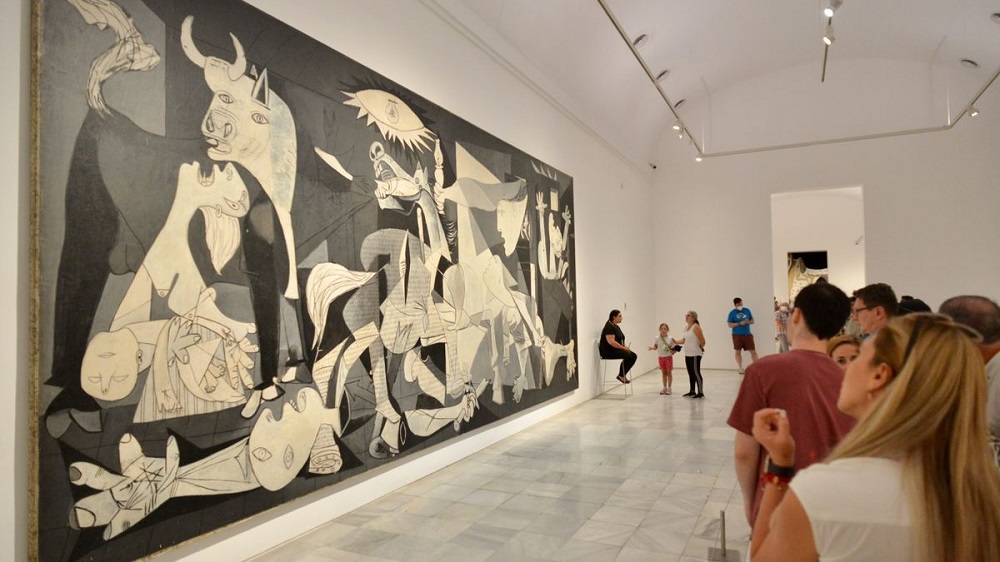
Floor 2 opens with Juan Gris, Braque and the Picasso of twenty years earlier, and almost everyone speed-walks it because they know what is at the end of the corridor. That is the mistake. Guernica is painted in a visual language you have to already read: the flattened planes, the single figure shown from two angles at once, the refusal of depth. Fifteen minutes here and the mural stops being a famous object and starts being a sentence you can follow.
It is Room 205.10 on Floor 2 of the Sabatini building, and the canvas is 349 by 777 centimetres, so the first thing to do is walk to the far wall and take it whole. Then come in close on the left edge, which is where the bull and the dismembered soldier are and where the crowd is not. The rooms either side hold the war posters and the documentary photography of the same months, and they are the reason the mural reads as reporting rather than allegory.
Everyone stops at Guernica and leaves. Keep going along Floor 2 for The Great Masturbator, painted in 1929, the year Dalí met Gala, with the soft head lifted from a rock at Cap de Creus. Miró's Man with a Pipe is on the same floor, and it is the 1925 version of a language he was still simplifying forty years later. Look for Ángeles Santos and Maruja Mallo too: two painters from the same years and the same city who get a fraction of the wall space. Floor 4 has Tàpies and Bacon and is worth it only if you still have legs.
Coach groups do Guernica before lunch and the free window starts at 19h Monday to Saturday. The couple of hours in between are the emptiest the room gets on a paying ticket.
The ban was lifted in September 2023. No flash, no tripods, but you can photograph everything.
The climate control on Floor 2 is set for the canvases, not for you. In July you will walk in from 35 degrees outside and want a layer within ten minutes.
Good collection (Tàpies, Bacon) but Floor 2 is where the essential works are.

Why it matters: Painted between 1 May and 4 June 1937 in Paris, for the Spanish Republic's pavilion at that year's World's Fair, weeks after the bombing it records. It stayed at MoMA in New York until 1981 because Picasso refused to send it to Spain while Franco was alive.
What to notice: Stand at the far wall first: at 349 by 777 centimetres you cannot read it from close up. Then walk to the left edge, where the bull stands over the woman with the dead child and the severed arm still holds a broken sword. Most of the crowd stays dead centre and never looks there.

Why it matters: Dalí's most personal Surrealist work. Painted the summer he met Gala, the central figure melts between desire, shame, and hallucination.
What to notice: The soft, drooping face is a self-portrait — based on a rock formation at Cap de Creus. Follow the chain of images from bottom-left to top-right: each element connects to the next like a dream sequence.

Why it matters: Miró at the crossroads between figuration and his own visual language. You can still find the man — barely.
What to notice: Look for the pipe first — it's the most recognizable element. Then trace outward: the body dissolves into symbols. Compare this with the Cubist works you saw earlier — Miró takes fragmentation further.
How well did you look?
3 quick questions about what you just saw
Visit complete!
Share your visit or save it for later
Your collection