Las Meninas at the Prado: Where to Stand in Room 12
Las Meninas is in Room 12, first floor. You'll find it in ten minutes. The question isn't where it is — it's where to stand.
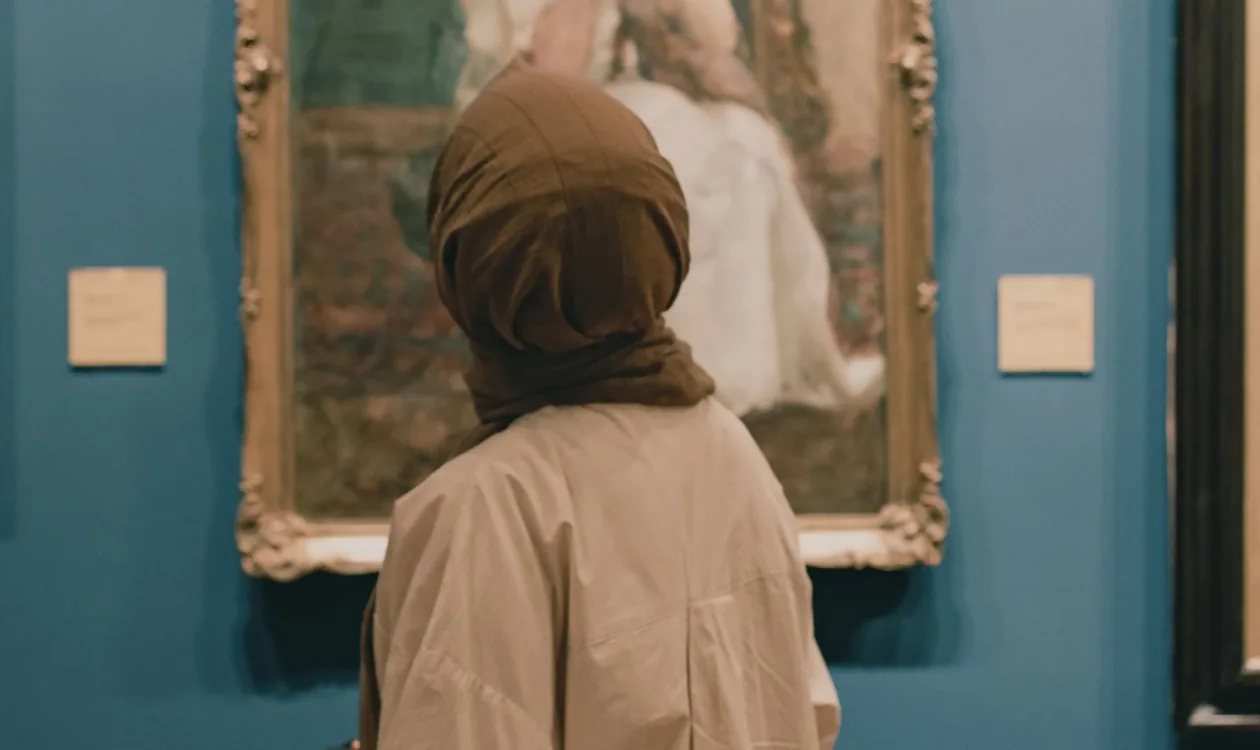
Las Meninas is in Room 12, on the first floor of the Prado. You'll find it within ten minutes of walking in, hanging on a long wall with benches in front. The question was never where it is. It's where you stand to see what Velázquez actually built.
In 3 minutes, you'll know:
- The spot in Room 12 the whole painting was calculated from
- What to look at first, and the order that makes sense
- The mirror debate, in plain language
What you're actually looking at
Velázquez painted this in 1656, and it's large: 318 by 276 cm, taller than a person and wider than a doorway. In the centre stands the five-year-old Infanta Margarita Teresa, surrounded by her maids of honour, two court dwarfs, a dog, and a chaperone. On the left, Velázquez painted himself at a huge canvas, brush in hand.
On the back wall hangs a mirror, and in it you see King Philip IV and Queen Mariana. That mirror is the engine of the painting. It puts the royal couple somewhere outside the frame, roughly where you're standing.
If you're still sorting out tickets or the free evening slot, the Prado tickets guide covers the booking side separately.
The Prado guide — your 2-hour route on your phone
- Room-by-room route to Velázquez, Goya, and Bosch without backtracking
- Exact rooms: 12 for Las Meninas, 66-67 for Goya, 56A for Bosch
- The best 90 minutes if you only have one visit
- Built for your phone — open it inside the museum
Where to stand, and why it matters
Step back to about four metres, directly in front of the painting, and look for the point where the floor and ceiling lines seem to converge. That's the spot Velázquez calculated the perspective from. Stand there and the room in the painting lines up with the room you're in.
It's also, by most readings, the spot the king and queen occupy, the place their reflection comes from. Standing there is the experience most visitors miss because they crowd in close to find the Infanta's face. The painting was built for distance.
What to look at first
- The mirror on the back wall, with the king and queen.
- Velázquez himself on the left, and the red cross of the Order of Santiago on his chest.
- The Infanta Margarita in the centre, lit like the heart of the scene.
- The man in the lit doorway at the back, pausing on the stairs.
- The dog in the foreground, fully visible only if you step to the left.
Five details most visitors miss
- The cross of Santiago on Velázquez's chest was added after the painting was done. He was knighted in 1659, three years later, and a story says Philip IV had it painted in himself.
- The figure in the back doorway is José Nieto, the queen's chamberlain, caught mid-step.
- The dwarf Maribárbola looks straight out at you, rare for a portrait of the period.
- The room itself is a hall of the old Alcázar palace, which burned down in 1734. The painting is the record of a room that no longer exists.
- X-rays show Velázquez repainted his own pose at least twice before settling it.
What's going on with the mirror?
This is the part people argue about, and the argument is the fun of it. One reading: the mirror reflects the king and queen, who are posing in front of the painting, exactly where you stand. By that logic, you're standing in the royal spot.
The other reading: the mirror reflects the large canvas Velázquez is painting, which would be a portrait of the royal couple. The two theories can't both be fully true, and Velázquez left no note. Foucault built the opening of his 1966 book on exactly this uncertainty. You don't need the theory to feel it. Stand at four metres and the question becomes obvious on its own.
When should you visit Room 12?
Room 12 is busiest between 11:00 and 14:00. Visitors report the clearest view right at the 10:00 opening or after 16:00, when the tour groups thin out. The painting is not behind glass, so there's no reflection to fight, only people. Get there early and you can hold the four-metre spot for a minute on your own.
Practical information
- Location
- Room 12, first floor, Villanueva building
- Hours
- Mon–Sat 10:00–20:00, Sun & holidays 10:00–19:00
- Price
- €15 general, €7.50 reduced. Free under 18 and students 18–25
- Free entry
- Mon–Sat 18:00–20:00, Sun 17:00–19:00 — on-site box office only, not bookable online
- Book tickets
- GetYourGuide (non-refundable, 4.6★) · museodelprado.es (€15, official)
- Photography
- Allowed without flash. No tripods or selfie sticks
- Metro
- Banco de España (L2, 3 min) or Estación del Arte (L1, 8 min)
Hours and prices can change. Confirm on the official website before your visit.
Last verified: June 2026
Frequently asked questions
Where is Las Meninas in the Prado?
Room 12, on the first floor of the Villanueva building, in the heart of the Velázquez galleries. You'll reach it within about ten minutes of entering. Ask a guard for "Sala 12" if you lose your way.
Why is Las Meninas famous?
Velázquez painted himself into a royal portrait, put the king and queen in a mirror on the back wall, and placed the viewer where the royal couple would stand. It folds the painter, the subject, and the person looking into one space. The philosopher Michel Foucault opened a whole book on it in 1966, and painters from Picasso onward have reworked it.
Can you take photos of Las Meninas?
Yes, without flash, like the rest of the permanent collection. The painting is not behind glass, so you get a clean view with no reflections. Tripods and selfie sticks are not allowed.
Is Las Meninas worth seeing during the free evening slot?
Yes, and it's included in the free hours. Room 12 is one of the first places free-slot visitors head for, so it fills fast. If you go in the free window, walk straight to Room 12 before the crowd builds.
One painting can carry a whole visit. For the route that takes you from Room 12 to Goya and Bosch without doubling back, see the Prado room-by-room guide, and for timing the free hours, the free admission guide.
Already subscribed? Open the room-by-room guide →