Bosch's Garden of Earthly Delights at the Prado: Room 56A
The triptych is in Room 56A. Most people read the three open panels and leave, and miss the image on the back of the closed shutters.
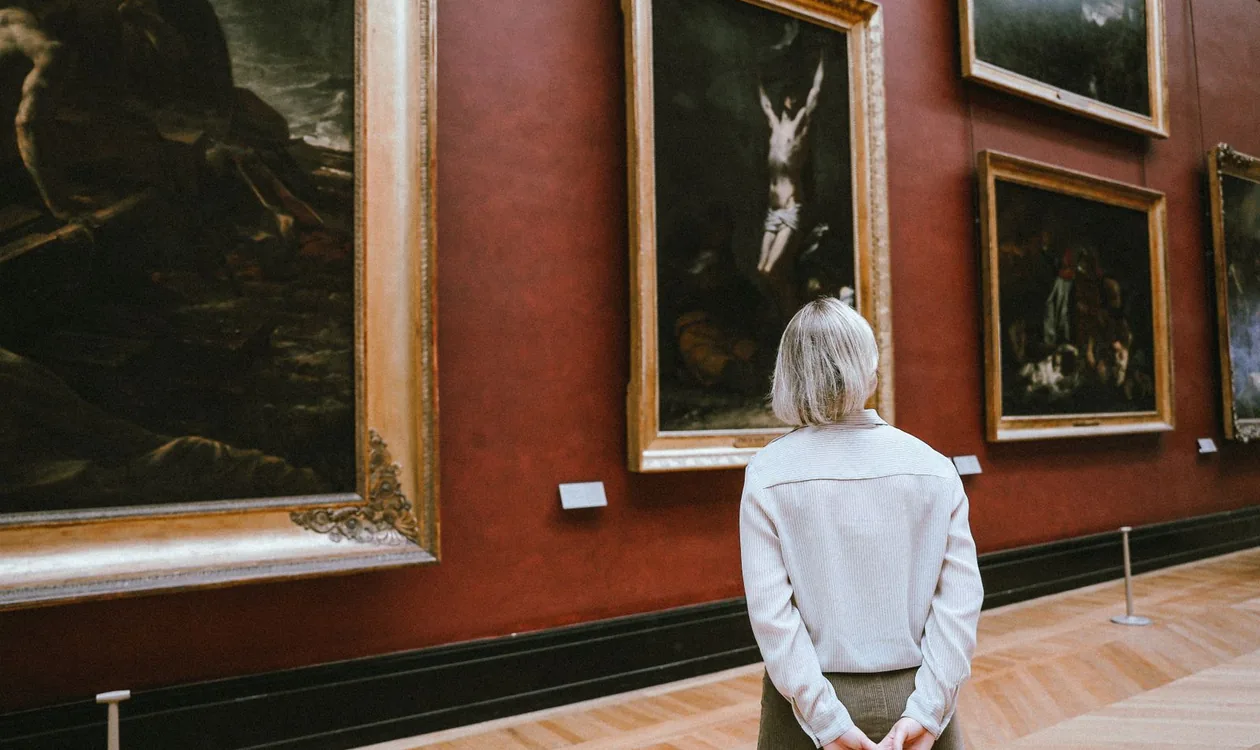
Bosch's Garden of Earthly Delights is in Room 56A of the Prado, standing in a glass case you can walk around. Most visitors face the three open panels, take a photo, and move on. The back of the closed shutters has its own image, and walking around to see it first changes how you read everything on the front.
In 3 minutes, you'll know:
- Where the triptych is and why its case matters
- The order to look at the panels in, starting from behind
- The five details people walk past without noticing
What you're actually looking at
A triptych is a painting in three hinged panels. Closed, you see one image. Open, you see three. Bosch built this one to be read left to right: Eden on the left, a crowded garden in the centre, hell on the right. The Prado dates it to around 1490 to 1500, and tree-ring analysis of the oak confirms it can't be earlier than the 1460s.
The painting was studied in depth around 2016, the year of the Prado's Bosch 500th-anniversary show, when the museum's conservation team published high-resolution scans of every figure. That research is why we can now talk about details no naked eye catches in a gallery.
If you're sorting out tickets and the free evening slot, the Prado tickets guide covers the booking side separately.
The Prado guide — your 2-hour route on your phone
- Room-by-room route to Bosch, Velázquez, and Goya without backtracking
- Exact rooms: 56A for Bosch, 12 for Las Meninas, 66-67 for Goya
- The best 90 minutes if you only have one visit
- Built for your phone — open it inside the museum
Start with the closed shutters
Before you look at the colour, walk around the case to the back. The closed exterior is painted in grey-green grisaille: the Earth on the third day of creation, sealed inside a transparent globe, with a small figure of God in the upper corner.
It sets the whole story in motion. You're seeing the world before people fill it. Then you come back around to the front, and the three panels read as what happened next. Most visitors skip this and lose the frame the painting was built around.
What to look for, panel by panel
Left panel, Eden. God presents Eve to Adam beside a pink fountain. Look for the animals that don't belong in any real garden: a giraffe, an elephant, hybrid creatures climbing out of the pond. This is paradise already tilting toward strange.
Central panel, the garden. Hundreds of nude figures move among oversized strawberries, cherries, and birds the size of people. Count the fruit before you judge the scene. In Bosch's time, fruit this size was shorthand for pleasure that doesn't last. Whether the figures are sinning or simply free is the argument the painting refuses to settle.
Right panel, hell. A city burns in the background. At the centre stands the Tree-Man, his torso a cracked eggshell with a tavern inside it. Musical instruments become instruments of torture here, gamblers are punished at their own tables, and the whole panel inverts the pleasures of the centre.
Five details most visitors miss
- The closed-shutter creation image, visible only if you walk behind the case.
- The "butt music" in the hell panel: a musical score written across a figure's backside. A student at Oklahoma Christian University transcribed and recorded it in 2014, and you can find the audio online.
- The Tree-Man's face, which several scholars argue is a Bosch self-portrait.
- The owls scattered throughout, Bosch's recurring bird and a symbol that reads as either wisdom or evil depending on who you ask.
- The giant strawberry in the centre, the single clearest clue that the garden is about pleasure that vanishes.
What does the Garden of Earthly Delights mean?
Honestly, nobody knows for certain, and the museum doesn't pretend otherwise. The traditional reading is a moral warning: pleasure leads to the punishments on the right. A second reading treats the centre as a genuine lost paradise, humanity before shame. A third gives up on a single message and treats the painting as Bosch's private dream-logic.
What's verifiable is small. Bosch left almost no writing. The titles came later. So the honest position, and the one that makes the painting better to stand in front of, is that you're allowed to decide for yourself.
When should you visit Room 56A?
The room draws a steady crowd but rarely the crush that forms around Las Meninas. Visitors report the calmest viewing between 09:30 and 10:30, right at opening, or after 16:00. During the free evening slot the room fills up, especially on Sundays, so a paid early-morning ticket buys you the slow look this painting needs.
Practical information
- Location
- Room 56A, first floor, Villanueva building
- Hours
- Mon–Sat 10:00–20:00, Sun & holidays 10:00–19:00
- Price
- €15 general, €7.50 reduced. Free under 18 and students 18–25
- Free entry
- Mon–Sat 18:00–20:00, Sun 17:00–19:00 — on-site box office only, not bookable online
- Book tickets
- GetYourGuide (non-refundable, 4.6★) · museodelprado.es (€15, official)
- Photography
- Allowed without flash. No tripods or selfie sticks
- Metro
- Banco de España (L2, 3 min) or Estación del Arte (L1, 8 min)
Hours and prices can change. Confirm on the official website before your visit.
Last verified: June 2026
Frequently asked questions
Where is the Garden of Earthly Delights in the Prado?
Room 56A, on the first floor of the Villanueva building. The triptych stands in a free-standing case, so you can walk all the way around it. It's a few minutes from the main galleries — ask any guard for "Sala 56A" or "El Bosco".
What does the Garden of Earthly Delights mean?
There's no settled answer. The left panel shows Eden, the centre shows a vast garden of nude figures and giant fruit, and the right shows hell. Scholars read it as either a moral warning against earthly pleasure or, less commonly, a lost paradise. Bosch left no written explanation, so the museum presents it as an open question.
Can you take photos of the Garden of Earthly Delights?
Photos are allowed without flash, like the rest of the Prado's permanent collection. Tripods and selfie sticks are not. The low gallery light protects the pigments, so phone shots come out dark, and looking with your eyes rewards you more here than the camera does.
How long should you spend with the Garden of Earthly Delights?
Give it 30 to 45 minutes if you want to actually read it. The detail is the whole point: hundreds of small figures, the closed-shutter image on the back, and the right panel's catalogue of punishments. A two-minute glance is the most common visitor regret.
Stand with it longer than feels comfortable. This is one of the few paintings that keeps giving back the more time you put in. For the full route past it, the Prado room-by-room guide and the free admission timing are both worth a look before you go.
Already subscribed? Open the room-by-room guide →