Day Trips from Rome
Pompeii and Tivoli get sold as the day trip from Rome. Two of the best are half the travel time, and one of them costs €1.50 to reach on a metro ticket.
Every list of day trips from Rome opens with Pompeii, and Pompeii is a twelve-hour day. That is a fine way to spend a day, but it is not the only shape a day trip can take, and the lists rarely say so.
The seven below split on one number: how long you sit down. Ostia Antica is twenty-five minutes away on an urban train. Pompeii is two hours each way before you have walked anywhere.
In 3 minutes:
- Ostia Antica is the cheapest and closest Roman site: €1.50 each way on a normal city ticket, €18 to enter, closed Mondays.
- Pompeii tickets are nominative. Bring the passport or ID that matches the name on the booking, or you do not get in.
- A tour is worth paying for at Civita di Bagnoregio, arguably at Tivoli, and nowhere else on this list.
Which day trip from Rome should you pick?
| Travel each way | Entry | Tour worth it? | Go if | |
|---|---|---|---|---|
| Ostia Antica | ~25 min, urban train | €18 (valid 8 days) | No | You want Roman ruins and your day back |
| Tivoli | ~1 hour, FL2 | €15 + €15 | Marginal | You want gardens, not ruins |
| Bracciano | ~1 hour, FL3 | €10 | No | It is a Monday |
| Pompeii | ~2 hours | €20 | Guide yes, coach no | You will give it the whole day |
| Orvieto | 1h17 on the fast train | €8 | No | You want one great cathedral |
| Naples | ~1h10 | €20 for MANN | No | You have already done Pompeii |
| Civita di Bagnoregio | 2h+, train then bus | €5 | Yes | You want the photograph |
Read the first column before the last. Two of these give you six usable hours on the ground; two give you four, and you spend the rest sitting down.
Where to book
Our take: Two of the seven are worth a tour. Pompeii, because a guide at the gate changes what you see and the Circumvesuviana is unreliable. Civita di Bagnoregio, because the bus from Orvieto runs rarely and is badly signposted. For Ostia, Tivoli, Bracciano, Orvieto and Naples you want a train ticket, not a tour.
What are the best day trips from Rome?
Ostia Antica, if you want Rome's ruins without the day
Rome's own port city, and the most underrated thing within an hour of the centre. The Metromare line leaves from Roma Porta San Paolo, the station attached to Piramide on metro B, and Ostia Antica sits inside the urban fare zone. That means the €1.50 city ticket that gets you on the metro also gets you here.
Entry is €18, and the ticket is valid eight days across the park's sites, not one. Closed Mondays. In summer it opens at 08:30 and closes at 19:00, with last entry at 18:00, which is more usable daylight than most people realise.
What you get is a Roman town you walk through rather than look at from a rope: streets, apartment blocks, a theatre, a bakery, the black-and-white mosaics of the guild offices. Three to four hours is honest. No timed entry, no booking, no queue. A tour here adds cost and removes the ability to linger, which is the entire point of the place.
Tivoli, if you want gardens rather than ruins
An hour out on the FL2 regional line from Roma Tiburtina, with around thirty direct trains a day. Two sites, both €15, and they are not in the same place.
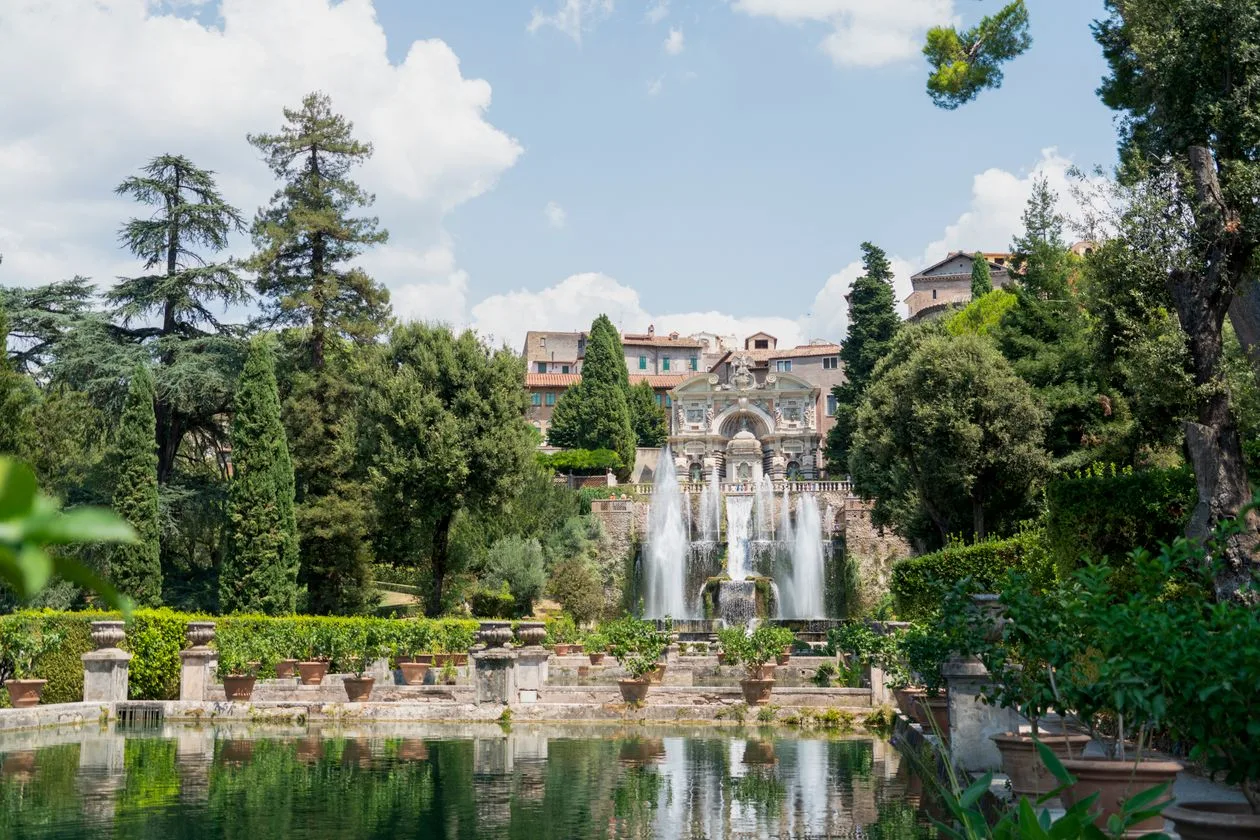
Villa d'Este is in the town: a sixteenth-century garden built as a hydraulic show, with five hundred fountains running on gravity alone. Villa Adriana, Hadrian's villa, is about six kilometres outside town and needs the local CAT bus, line 4 or 4X. Every 4 and 4X service between 08:30 and 19:30 diverts to the Villa Adriana stop, which is the single fact that decides whether your day works.
Two scheduling notes worth having. Villa d'Este opens at 14:00 on Mondays, so a Monday morning there is a closed gate, and a Monday afternoon is fine. And the BIRG three-zone day ticket, €9.50, covers Tivoli and all your ATAC travel in Rome that day, so it absorbs the metro rides at both ends.
This is the one destination on the list where a tour has real logic, because it solves the Villa d'Este to Villa Adriana transfer, which is the whole friction of the day.
Bracciano, if it is a Monday
A lake, a castle, and a regional train from Roma Ostiense on the FL3 line, around an hour. The Castello Orsini-Odescalchi is €10, and it is open every day of the year except 25 December, which makes it the answer to a problem the rest of this list creates: Ostia Antica shuts on Mondays, Villa d'Este shuts on Monday mornings, and Naples shuts its best museum on Tuesdays.
On Sundays and public holidays the guided tour is included in the €10 with no supplement. Two hours in the castle, two by the lake, and you are back in Rome for dinner.
Pompeii, if you will give it the whole day
Rome to Naples is about 1 hour 10 minutes on the high-speed line, then the Circumvesuviana out to Pompei Scavi. Entry is €20, or €25 for Pompeii Plus, which adds the Villa of the Mysteries, the Villa of Diomedes and Boscoreale with a shuttle between them. Pompeii Plus Extended is €30 and valid three days.
The rule that catches people out is the ticketing regime introduced in November 2024. Tickets are nominative — your name is printed on them and you need ID or a passport at purchase and at entry — and the site caps at 20,000 visitors a day. In high season, from 16 March to 14 October, entry is split into two slots that are not the same size: 15,000 places between 09:00 and 13:00, and only 5,000 between 13:00 and 17:30. The afternoon sells out in a way nobody expects.
A guide at the gate earns their money here, because Pompeii is genuinely hard to read alone. A Rome-based coach tour does not, because it spends four to five hours of your day in traffic that a train does in one. The full Pompeii guide has the honest cost comparison.
Orvieto, if you want one great thing
An Umbrian hill town on a volcanic plug, reached from Roma Termini in as little as 1 hour 17 minutes on the Intercity. Take that train, not the slower regional services, or the average journey stretches close to two hours.
The cathedral is €8, and that single ticket covers the San Brizio chapel with Signorelli's Last Judgement, the Museo Emilio Greco and the Duomo underground. Ignore the Carta Unica at €35 unless you are staying: it covers eight sites and is valid a full year, which tells you it was designed for repeat visitors, not for someone with five hours. If you want one more thing, the €11 combination that adds the Faina Etruscan museum is the correct upgrade.
Naples, if you have already done Pompeii
The same 1 hour 10 minutes as Pompeii, without the second train. The reason to come as a day-tripper is MANN, the National Archaeological Museum, at €20: it holds the actual frescoes and mosaics lifted out of Pompeii, so the correct sequence is Pompeii one day and MANN another, not either alone.
Do not go on a Tuesday, when MANN is closed. Otherwise it runs 09:00 to 19:30 with last entry at 18:30. Our MANN guide covers what to see in the two and a half hours you will have.
Civita di Bagnoregio, if you want the photograph
The town on a crumbling pedestal of tufa, reached by footbridge. Entry to the town is €5, which is an access fee for the bridge rather than a ticket to anything, and guests staying in the village enter free.
Getting there is train to Orvieto and then a Cotral bus, and this is the weak link: the connection is infrequent and the timetable is close to undocumented online. A missed return bus strands you. It is the one destination here where paying someone else to solve the logistics is defensible, usually paired with Orvieto on the same trip.
What most visitors get wrong
They start with Pompeii because every list does, and then discover they have committed a full day out of a four-day Rome trip. If you have five days or more, Pompeii is worth it. If you have three, Ostia Antica gives you eighty per cent of the same experience for a quarter of the time.
They also skip Florence's actual problem. Rome to Florence is 1 hour 32 minutes at best, which is over three hours of high-speed fares round trip, into a city where the Uffizi and the Accademia both need timed slots booked ahead. You arrive, queue in someone else's city, and leave before dinner. Florence deserves two nights, not eight hours.
And they plan a Monday like any other day. In Rome that is survivable; outside it, half these sites are shut. Bracciano and Pompeii are your Monday options, and Villa d'Este after 14:00.
If you would rather stay in the city, things to do in Rome covers the centre, and free museums in Rome covers the days when the entry prices above do not apply.
- Ostia Antica
- ~25 min from Porta San Paolo (Piramide, metro B) · €1.50 urban ticket each way · entry €18, valid 8 days · closed Mondays
- Tivoli
- ~1 hour, FL2 from Roma Tiburtina · Villa Adriana €15 · Villa d'Este €15, opens 14:00 on Mondays · BIRG 3-zone day ticket €9.50
- Bracciano
- ~1 hour, FL3 from Roma Ostiense · castle €10 · open every day except 25 December
- Pompeii
- ~2 hours via Naples · €20, Pompeii Plus €25, Plus Extended €30 · nominative tickets, ID required · 20,000/day cap
- Orvieto
- From 1h17, Roma Termini · Duomo €8 including San Brizio and the underground · €11 with the Faina museum
- Naples
- ~1h10, Roma Termini · MANN €20 · closed Tuesdays · 09:00–19:30, last entry 18:30
- Civita di Bagnoregio
- Train to Orvieto then Cotral bus · €5 town access · free for guests staying in the village
- Book day trips
- Day trips from Rome on GetYourGuide — free cancellation on most tours
Regional and high-speed fares change with demand and are not published as fixed tables. Confirm entry prices and opening days before you travel.
Last verified: July 2026
Frequently asked questions
What is the best day trip from Rome?
Ostia Antica if you want Roman ruins without the travel: a 25-minute urban train on a €1.50 ticket, and a site that takes 3 to 4 hours. Pompeii if you accept a 12-hour day for the most complete Roman town in the world. Tivoli if you want gardens and a villa rather than a ruin field. Ostia is the one most visitors do not consider and the one most of them should pick.
Can you do Pompeii as a day trip from Rome?
Yes, but plan it as a full day. Rome to Naples is about 1 hour 10 minutes on a high-speed train, then roughly 35 to 40 minutes on the Circumvesuviana to Pompei Scavi. Tickets are nominative since November 2024, so you need photo ID matching the name on the ticket, and the site caps at 20,000 visitors a day.
Which day trip from Rome is cheapest?
Ostia Antica. It sits inside Rome's urban transport zone, so the return trip is two €1.50 tickets, and entry is €18 for a ticket valid eight days. Nothing else on this list comes close, because everything else needs a regional or high-speed train.
Do you need a guided tour for day trips from Rome?
For most of them, no. Ostia, Orvieto, Naples and Bracciano are direct trains to walkable places. Pompeii benefits from a guide at the gate, though not from a Rome-based coach that spends four hours in traffic. Civita di Bagnoregio is the one where a tour genuinely helps, because the bus connection from Orvieto is infrequent and badly documented.
Is Florence a good day trip from Rome?
No. The fastest train is about 1 hour 32 minutes, so you spend over three hours travelling at high-speed prices, and both headline sights, the Uffizi and the Accademia, need timed slots booked in advance. Florence is a two-night city. As a day trip it delivers a walk to the Duomo and a train home.
Pick by the first column of that table. What you like is your business; the hours on a train are the same for everyone.
- Pompeii Day Trip from Rome 2026: How to Get There & What to See
- Colosseum Tickets 2026: Prices & How to Book
- Vatican Museums Tickets 2026: Prices & How to Book
- Naples Archaeological Museum (MANN): What to See
- Things to Do in Rome: An Art Lover's Honest Guide