The Lift Sends Everyone to the Roof. Go There Second.
A room-by-room route through Casa Milà — the courtyards, the 270-arch attic, the 29 chimneys, and the 1911 flat almost nobody slows down in.
Get your free guide
Enter your email to unlock the full room-by-room guide. One email unlocks all Barcelona museum guides.
Free · No spam · Unsubscribe anytime
The building hands you the roof first, because the lift only stops at the top. Everyone in your time slot arrives there in the same three minutes. Walk the attic first and let them clear.
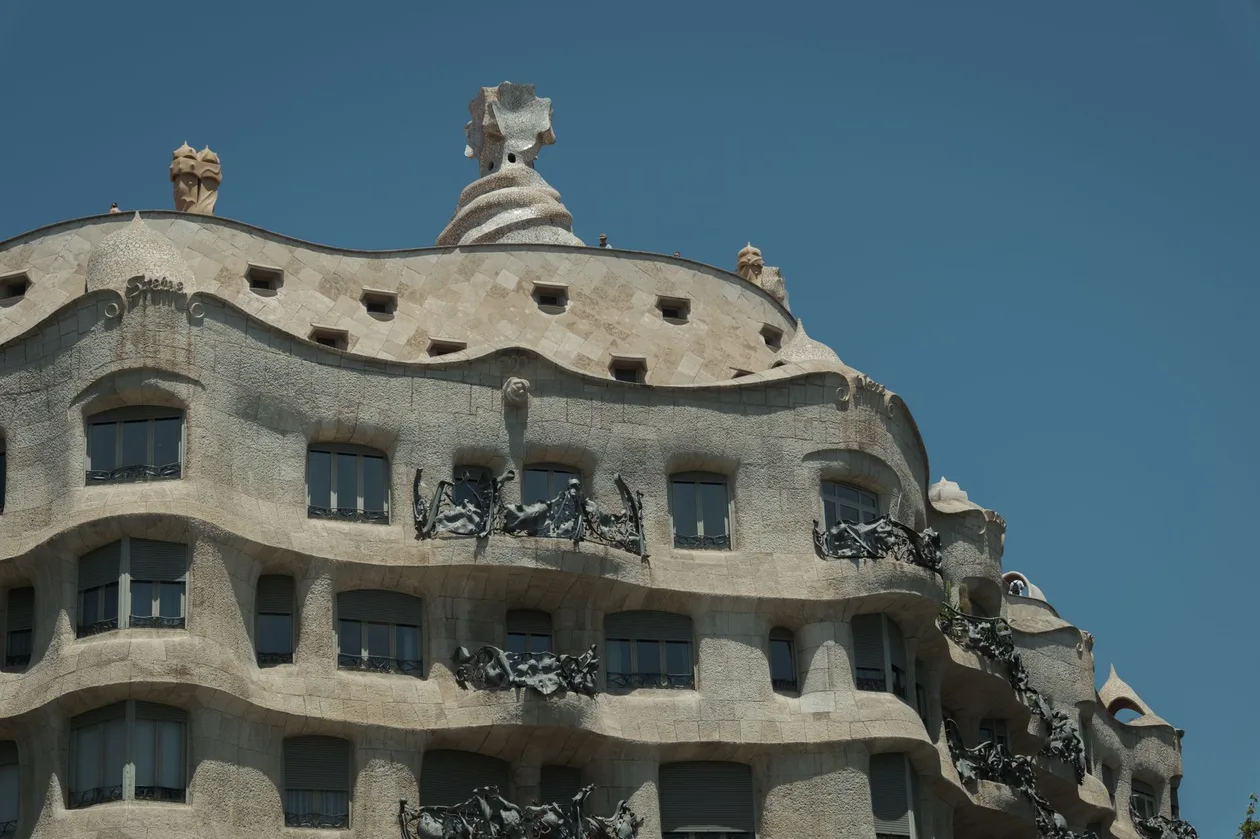
You will be funnelled towards the lift within about ninety seconds of entering, and the courtyard you crossed to get there is one of the strangest structures in the building. If you came in from Passeig de Gràcia, look up: the floor above you is carried by two concentric cylindrical girders tensioned by radial beams, the way a bicycle wheel works, spanning twelve metres on an eighty-centimetre structure. The mural tapestries on the walls are by the Symbolist painter Aleix Clapés. On the Passeig de Gràcia side they tell the love of Vertumnus and Pomona from Ovid; on the Provença side, the deadly sins alongside the heroes of the Trojan War.
The lift stops here. Resist the sign pointing outside and walk the attic first, while your slot empties onto the roof. Gaudí covered this floor with 270 brick catenary arches so the roof would not add weight to the building, and they stand on their own with no buttresses. Before it was the Espai Gaudí it was the communal laundry, the storage, the lift machinery and the building's thermal chamber: windows open in summer for the draught, shut in winter to trap the heat. The exhibition inside it is the only one in Barcelona that covers Gaudí's whole career rather than a single building, which is why it is worth doing before Park Güell and Sagrada Família rather than after. Walk the perimeter walkway too, and count the four cupolas shaped like Prussian helmets.
Six stairwell exits, the badalots, at seven metres each, with a spiral staircase inside every one. Twenty-nine chimneys at four metres, flues from a coal-fired central heating system that no longer exists, standing alone or grouped in twos, fives and sevens. Two ventilation towers at five metres that used to change the air in the attic you just left. The stone railing around the edge undulates in the same rhythm as the façade below it. Give this half an hour rather than fifteen minutes, and walk the full perimeter: the roof reads differently from each of its four sides.
A 1911 flat furnished as a Barcelona family would have had it, and the part of the visit people move through fastest. Look up. Gaudí drew the ceilings curved and had the plasterer reproduce circumferences, ellipses, spirals and scrolls over a braided reed frame, which is where the Spanish name techos planos de caña comes from. Some of them carry inscriptions. Then look at the doors: the sliding partition between living and dining rooms folds entirely into the side walls, and the front doors have iron-strip viewers so you could speak to someone without opening them. One absence explains the building: there is no main staircase. Gaudí got rid of it and gave the tenants lifts, which in 1911 was the radical part.
The lift only serves the top floor, so an entire time slot lands at the same door within a couple of minutes. Doing the attic first puts you on the roof once that wave has moved on.
La Pedrera Sunset (€25, 17:30 to 20:30) covers exactly the same spaces as the €29 Essential, with the same videoguide. The museum's own FAQ names after 4 PM as one of the two quietest windows.
The rooftop closes in rain. La Pedrera will reschedule you to another date only while the ticket is unvalidated. Once it is scanned, no changes. Ask at the door whether the roof is open before you go through.
Pushchairs are not allowed and have to be left at the entrance. The rooftop and the mezzanine are not wheelchair or pram accessible either, because of the unevenness Gaudí built in. A baby carrier is the only way up.
The official FAQ states the ticket office adds processing fees and charges more than the website, and that online tickets use a separate entrance.
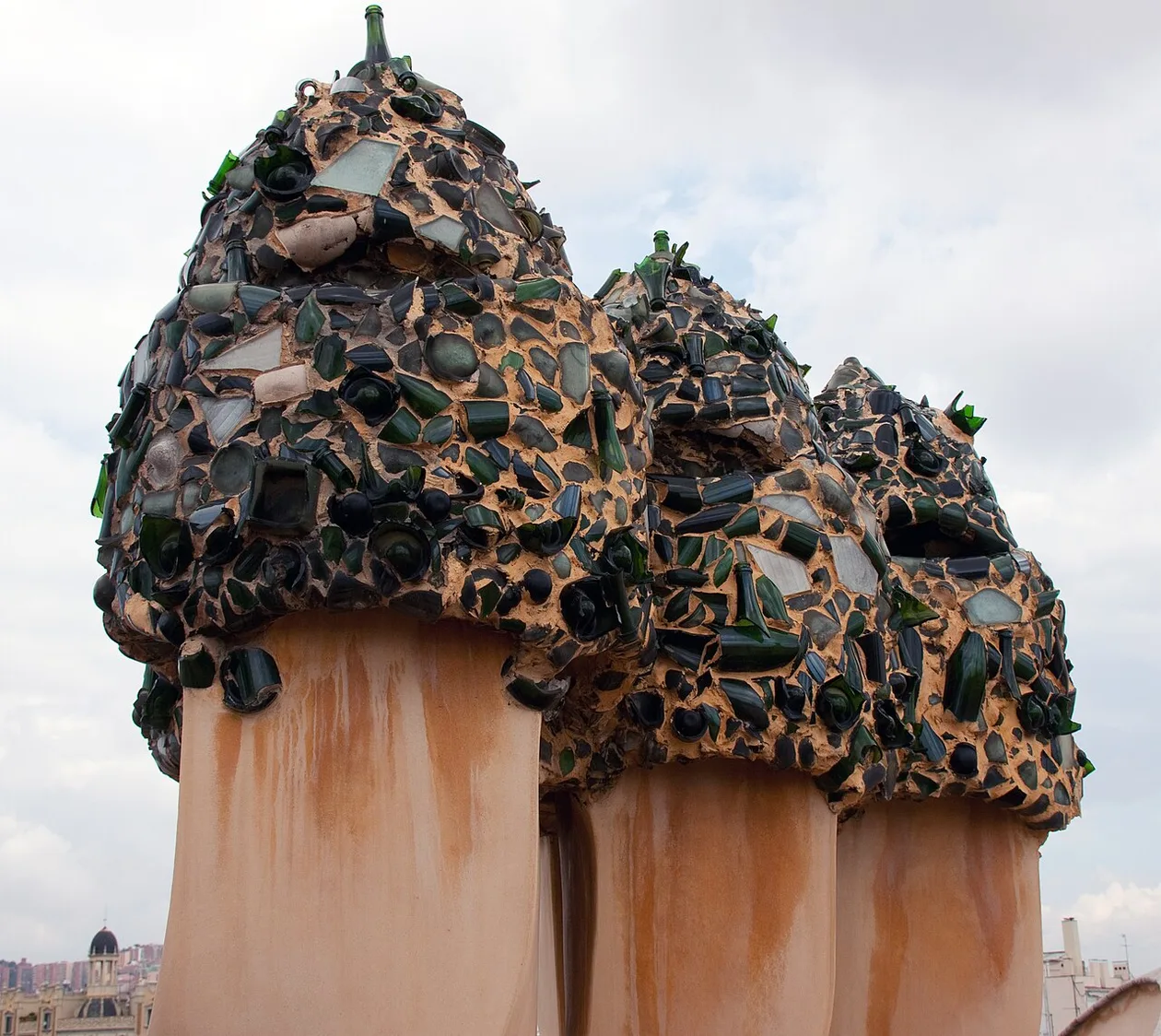
Why it matters: There are 29 chimneys up here and only one group of them is clad in trencadís, the broken-fragment mosaic Gaudí is known for. Everything else on the roof is lime mortar and plaster. The exception is the point.
What to notice: The green in that one group is not glaze. The fragments are dark green champagne bottles, broken and set into the mortar. Get close enough to see the curvature of the glass and the thickness of the shards.
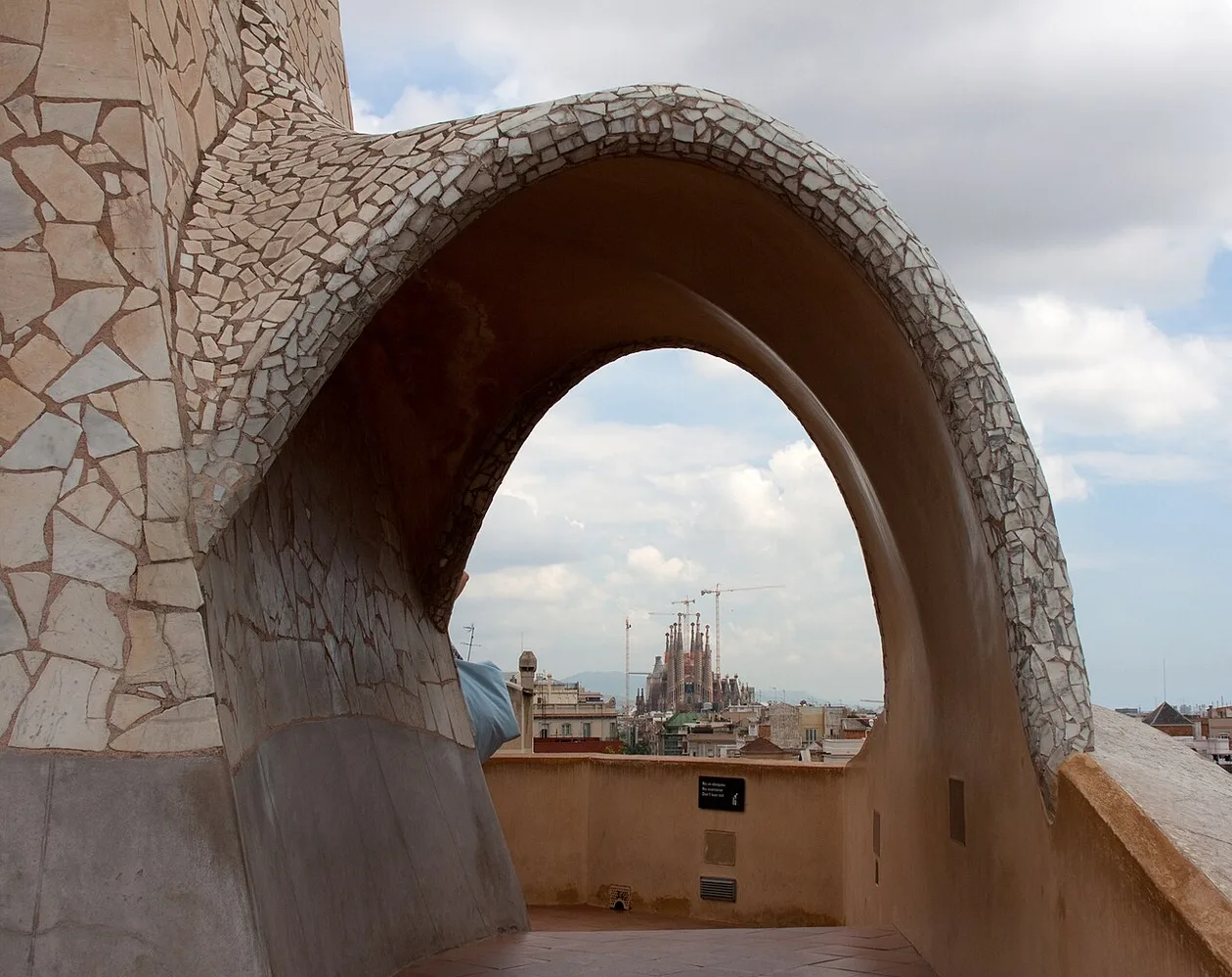
Why it matters: Gaudí built small white-trencadís arches on either side of two staircases to lock the structure together. One of them does a second job: it frames the Basilica of the Sagrada Família, and he calculated the height of the finished arch so that it would.
What to notice: Stand where the view lines up rather than photographing the arch straight on. It is the only place in Barcelona where one Gaudí building is deliberately composed inside another.
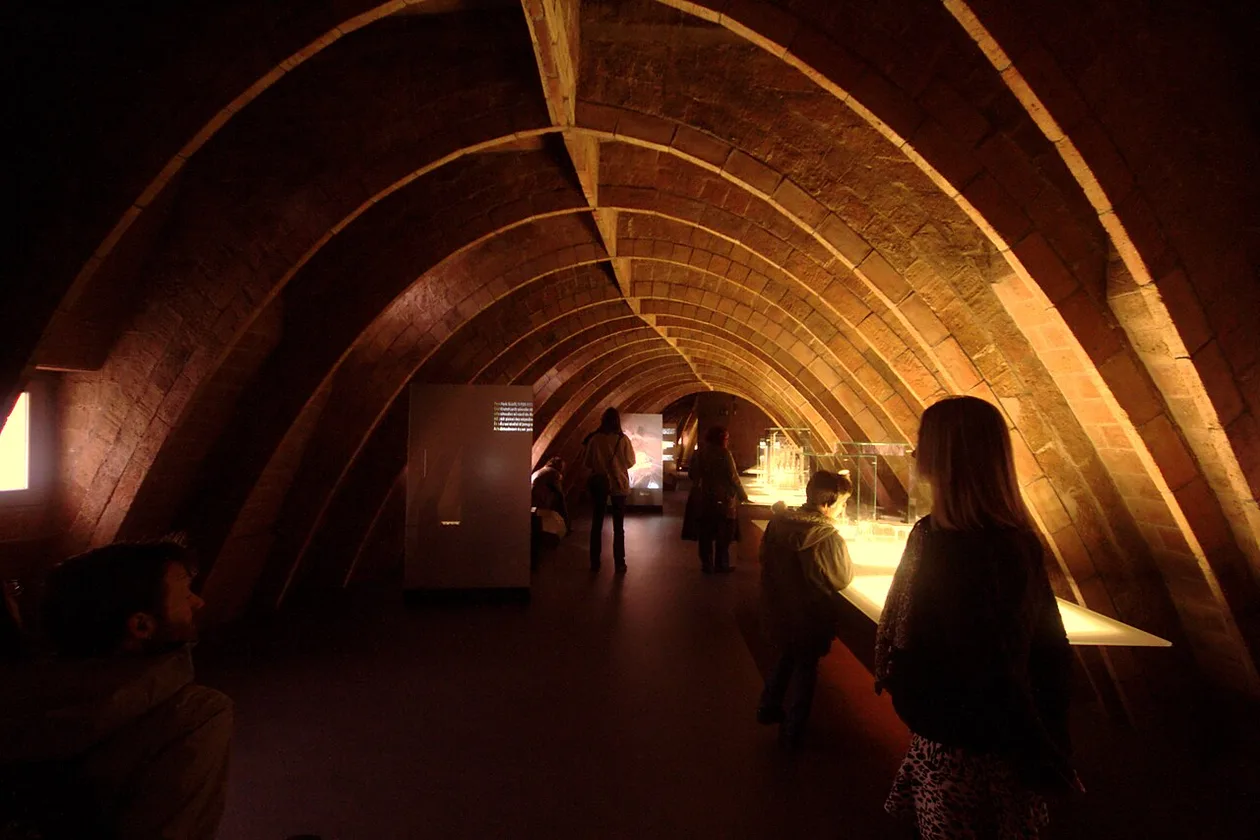
Why it matters: Gaudí needed a roof structure that weighed almost nothing, so he used a run of 270 brick arches he called balanced, or catenary. They are light, quick to build, need no buttresses and hold themselves up. This floor is the whole argument of his architecture in one room.
What to notice: The arches are not identical. Their height changes across the floor plan, which is what lets a single system follow the undulating outline of the building. Walk the length of the space and watch the ceiling rise and fall.
How well did you look?
3 quick questions about what you just saw
Visit complete!
Share your visit or save it for later
Your collection