Broken, room by room
A 90-minute route through the piano nobile, built around what each fragment lost and when it lost it
Get your free guide
Enter your email to unlock the full room-by-room guide. One email unlocks all Florence museum guides.
Free · No spam · Unsubscribe anytime
Every object in this show is here because something went wrong. Iconoclasm, war, revolution, a flood. The date of the damage is as much a part of the label as the date of the carving, and reading the rooms that way turns a display of broken things into a history of who broke them.
Mark Manders' installation sits in the Renaissance cortile and needs no ticket. Manders has spent thirty years making sculpture that looks unfinished or damaged on purpose, so seeing his work before the historical fragments upstairs sets up the question the exhibition never asks out loud: does a deliberately broken object mean the same as an accidentally broken one? Decide your answer down here, then go up and test it.
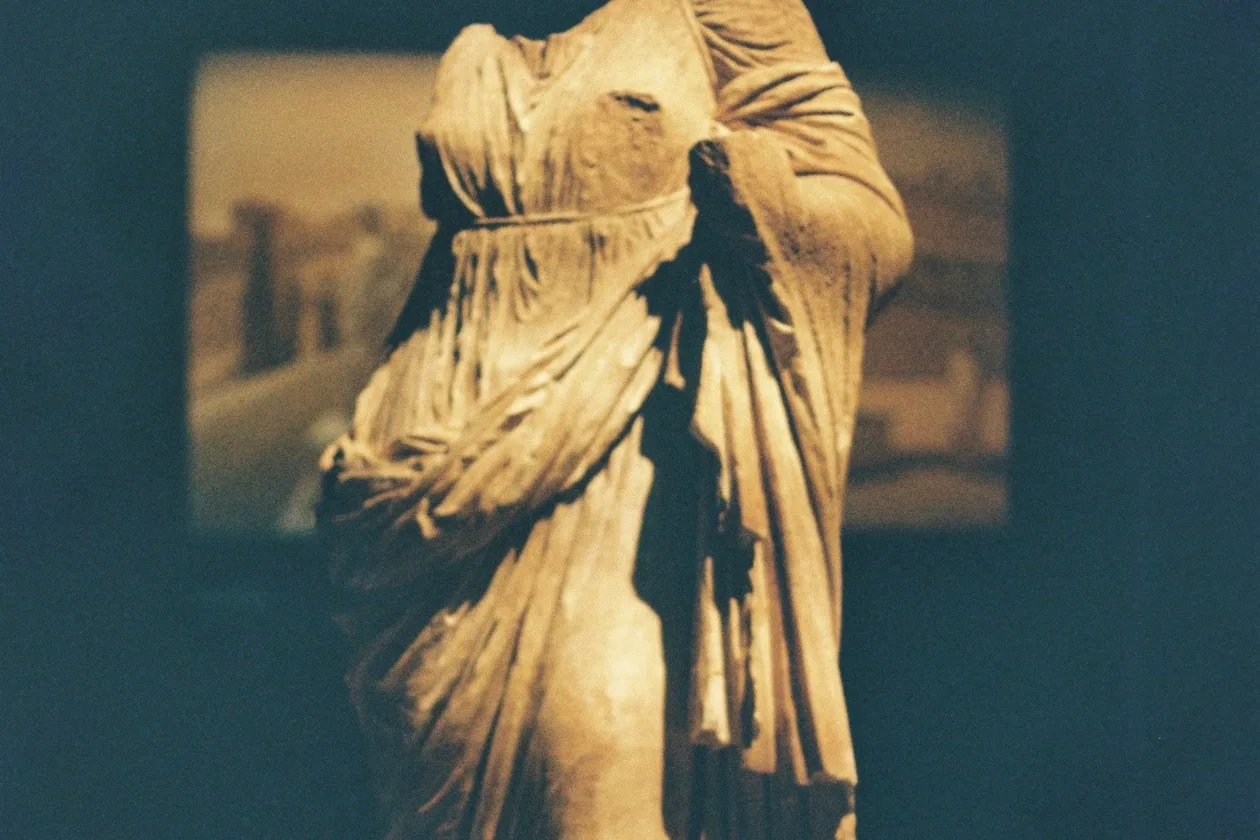
Do a full lap of the floor and look only at shapes. Which fragments read as complete objects and which read as wreckage? You will find the split has little to do with how much survives. A hand alone can feel whole; a torso missing only its head often does not. This is the curators' claim about autonomy, and it lands harder if you reach it yourself before a wall text hands it to you.
Second lap, different filter: ignore when each thing was made and track when it broke. The show's spine runs through ancient and Reformation iconoclasm, the French Revolution, both world wars, and the 1966 Florence flood. Grouping the room by destruction date rather than creation date rearranges it completely, and the flood section is the one where you are standing inside the history rather than looking at it.
Palazzo Strozzi has no permanent collection and closes between exhibitions. Google Maps keeps showing it as open during the gaps, which is the single most common complaint in its reviews. Broken runs 25 Sep 2026 to 24 Jan 2027. Outside those dates the paid floor may be empty.
Palazzo Strozzi lists Firenzecard under free entry and Firenzecard lists Strozzi with fast track and no reservation required. If you already hold the €85 card for the Uffizi and Accademia, this show costs you nothing extra. Most visitors assume a private foundation is excluded.
The palace stays open Thursdays until 23:00 and that late slot is a standing venue policy, not a per-show extra. Visitors report empty rooms after 19:30. The other reliable window is the 10:00 opening on a weekday. Avoid the last fortnight of the run.
Anything over 35×30×10 cm goes into the free combination lockers. That 10 cm depth rules out most day-packs and camera bags, not just luggage. Reviewers rate the lockers well and there is a free sparkling water dispenser beside them.
Why it matters: It has stood in the open courtyard of the Capitoline Museums since 1486. Five hundred and forty years of Roman weather, and five hundred and forty years of being walked past as part of the architecture rather than looked at as a sculpture.
What to notice: The index finger, and the surface. Outdoor marble weathers differently from anything kept inside: the exposed planes are sugared and slightly granular, the protected undercuts are still crisp. You are looking at two different rates of decay on one object, and the map of which is which tells you exactly how it sat in that courtyard for five centuries.
Why it matters: One of the earliest known bronze equestrian statues, and it has never been exhibited outside Greece. Bronze was valuable and recyclable, so large ancient bronzes were melted for their metal. The ones that reach us were buried, sunk or lost before anyone could reuse them.
What to notice: How little there is, and what that implies. Marble fragments are what remains after a break. Bronze fragments are what escaped a furnace. Stand between these and a marble piece and you are looking at two entirely different survival mechanisms, which is why the two materials give us such lopsided pictures of ancient sculpture.
Why it matters: Palazzo Strozzi picked this as the image of the entire exhibition. It is a sliver of Amarna stone holding a nose and a mouth, and no more, yet the Amarna style is distinct enough that it remains identifiably Akhenaten.
What to notice: The lips. Amarna sculpture exaggerated them deliberately, and that stylistic signature is doing the identification work that a face or a cartouche would normally do. Then consider that Akhenaten's images were attacked systematically after his death: this is not a fragment that time produced, it is one that someone made on purpose.
How well did you look?
3 quick questions about what you just saw
Visit complete!
Share your visit or save it for later
Your collection