Everyone Climbs It. Almost Nobody Reads It.
A level-by-level route through the Arc de Triomphe — the four sculpted groups at street level, the tomb under the vault, 284 steps, and the terrace on the historic axis.
Get your free guide
Enter your email to unlock the full room-by-room guide. One email unlocks all Paris museum guides.
Free · No spam · Unsubscribe anytime
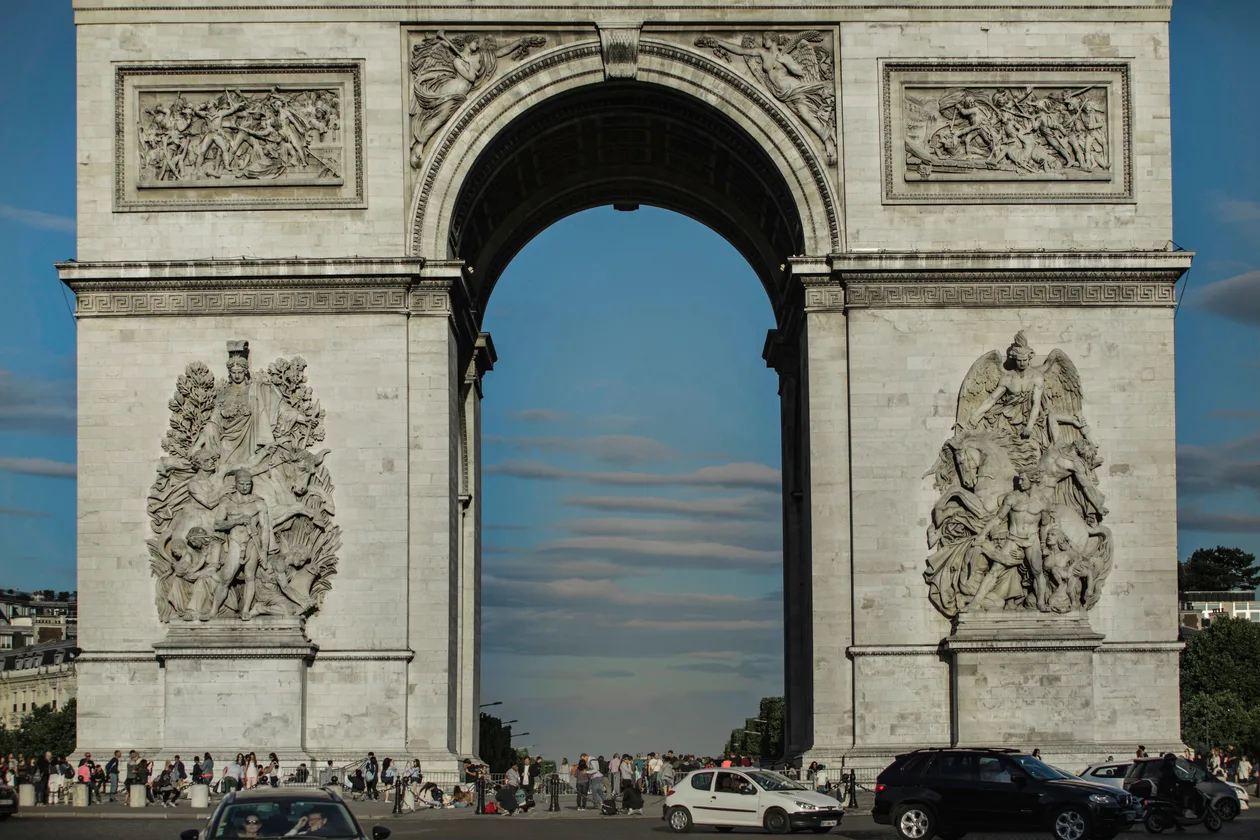
The queue goes straight up the stairs, which means the four sculpted groups you walked past on the way in are the part of the monument most visitors never actually look at. Do the outside first. It is free, and it is where the arch says what it is for.
Before the ticket desk, walk the terreplein once around the arch. The four high reliefs on the pillars were carved between 1833 and 1836 and each one names a specific year. On the Champs-Élysées face: Rude's Departure of the Volunteers for 1792 on the north-east pillar, and Cortot's Triumph of Napoleon for 1810 beside it. On the Grande-Armée face, both by Antoine Etex: The Resistance for 1814 and Peace for 1815. Read them in that order and you have the rise and the fall of an empire on four walls, in the order it happened.
Still no ticket needed. A soldier has lain under this vault since 11 November 1920, chosen at Verdun by a young corporal named Auguste Thin, who laid a bouquet on the sixth of eight identical coffins. The flame beside him was lit on 11 November 1923 and has not gone out since. If you can be here at 18:30, the veterans' association rekindles it, every single evening. Look up at the coffered vault while you wait: it is the same view Charles Godefroy had in August 1919 when he flew a biplane through the arch to protest at being made to march on foot.
Now you need the ticket. The staircase runs inside one of the pillars and it is a tight, continuous spiral of 240 steps, renovated in 2022, with almost nowhere to pull over. Go steadily; there is a drinking fountain inside the monument and you will want it. The spiral ends at the mezzanine and the museum hall, and this is the right place to stop rather than push straight on. Screens, a plaster cast and a scale model of the monument, plus seating and the accessible toilets. The free printed visit flyer is here in eleven languages.
The hard part is done. On the terrace, find the orientation tables and use the digital device on them, which names more than twenty monuments. Then do the axis deliberately: turn east down the Champs-Élysées to the Arc du Carrousel and the Louvre, then turn a full 180 degrees west to the Grande Arche de la Défense. That straight line is the reason the arch stands here. After that, pick off the Eiffel Tower one avenue away, the Invalides dome, Sacré-Cœur on its hill, the Panthéon, Tour Montparnasse and the Notre-Dame towers in the distance.
You cannot cross the Place Charles de Gaulle on foot, and the official site says so outright. Access is through the Passage du Souvenir, the underground passage entered at the top of the Champs-Élysées or on the Avenue de la Grande-Armée.
The full adult ticket is €22 from 1 April to 30 September, but €16 on Wednesdays inside that window, and €16 every day from 1 October to 31 March. Same monument, same ticket, six euros apart.
The official site has carried a maintenance banner since August 2026 saying the terrace is reachable by stairs only, and GetYourGuide dates the outage from 20 August. Even when it runs, the lift stops at the museum and shop level and the last flight is on foot.
Access to the Tomb of the Unknown Soldier is free, every day, no ticket. What you pay for is the staircase, the museum hall and the terrace. If the stairs are not going to work for you, the historically serious half of the monument still is.
This is a working national monument. Annual closures are 1 May, 8 May, 14 July and 11 November in the morning, and the 2026 calendar also carries dated early closes and one full Saturday closure in September. In the June 2026 heatwave it ran 10:00 to 14:30 for six days.
The monument gives away a web app at app.paris-arc-de-triomphe.fr in five languages with three routes through the building, no download needed, plus a printed flyer in eleven languages at the museum hall.
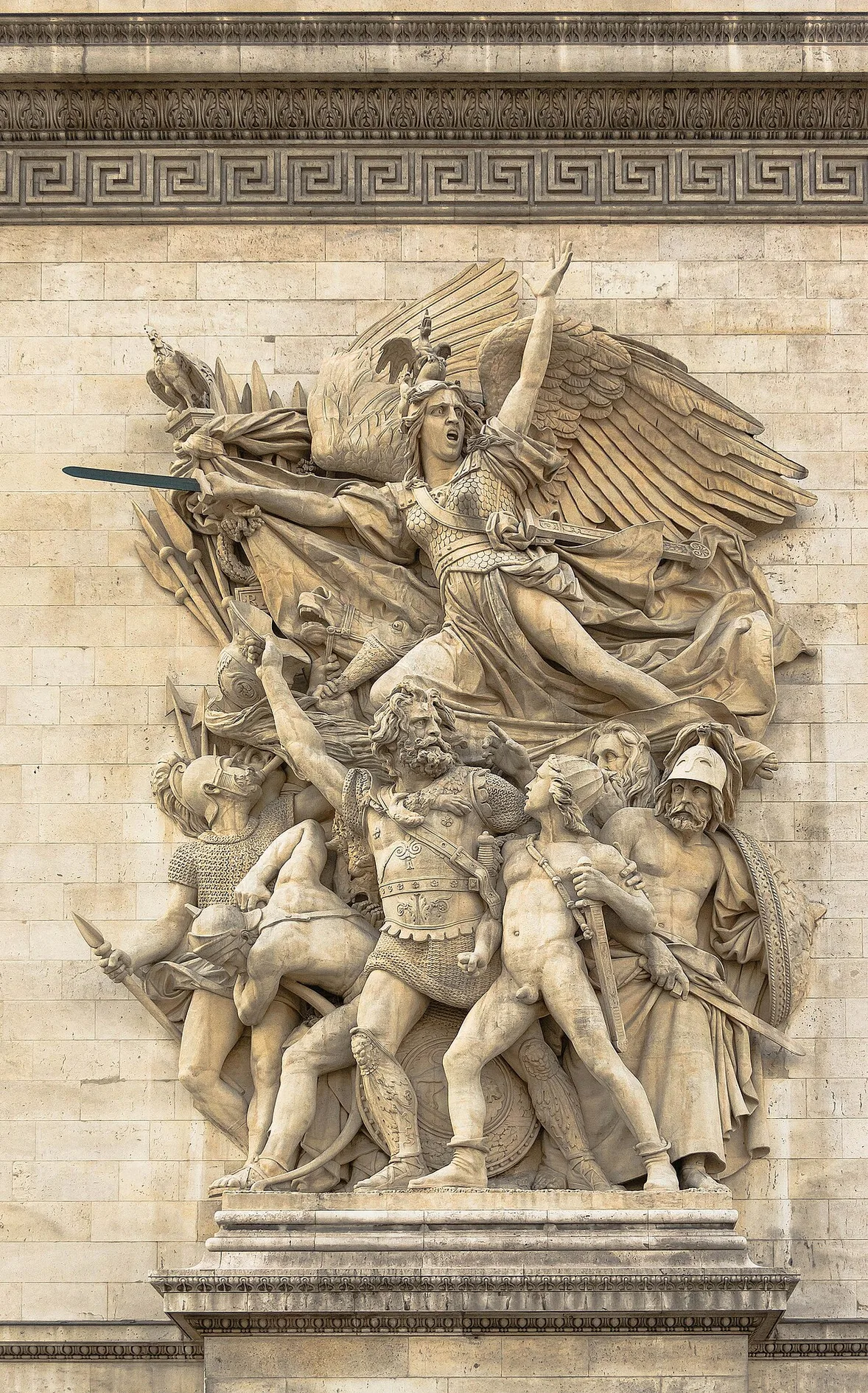
Why it matters: The one on every postcard, and the reason people photograph this face of the arch without knowing what they are photographing. It marks the conscription of 1792, when the Legislative Assembly called up close to 200,000 men to defend a revolution that most of Europe had lined up against.
What to notice: Rude refused to date it. No revolutionary uniforms, no 1792 weapons, everything in an invented antique dress, so that it reads as any people defending anything. Then look at the winged woman above: the Génie de la Liberté with her mouth open, mid-shout, sword up. Below her a bearded warrior in a cuirass drags a naked young man off by the shoulder while an old man behind them is plainly still arguing.
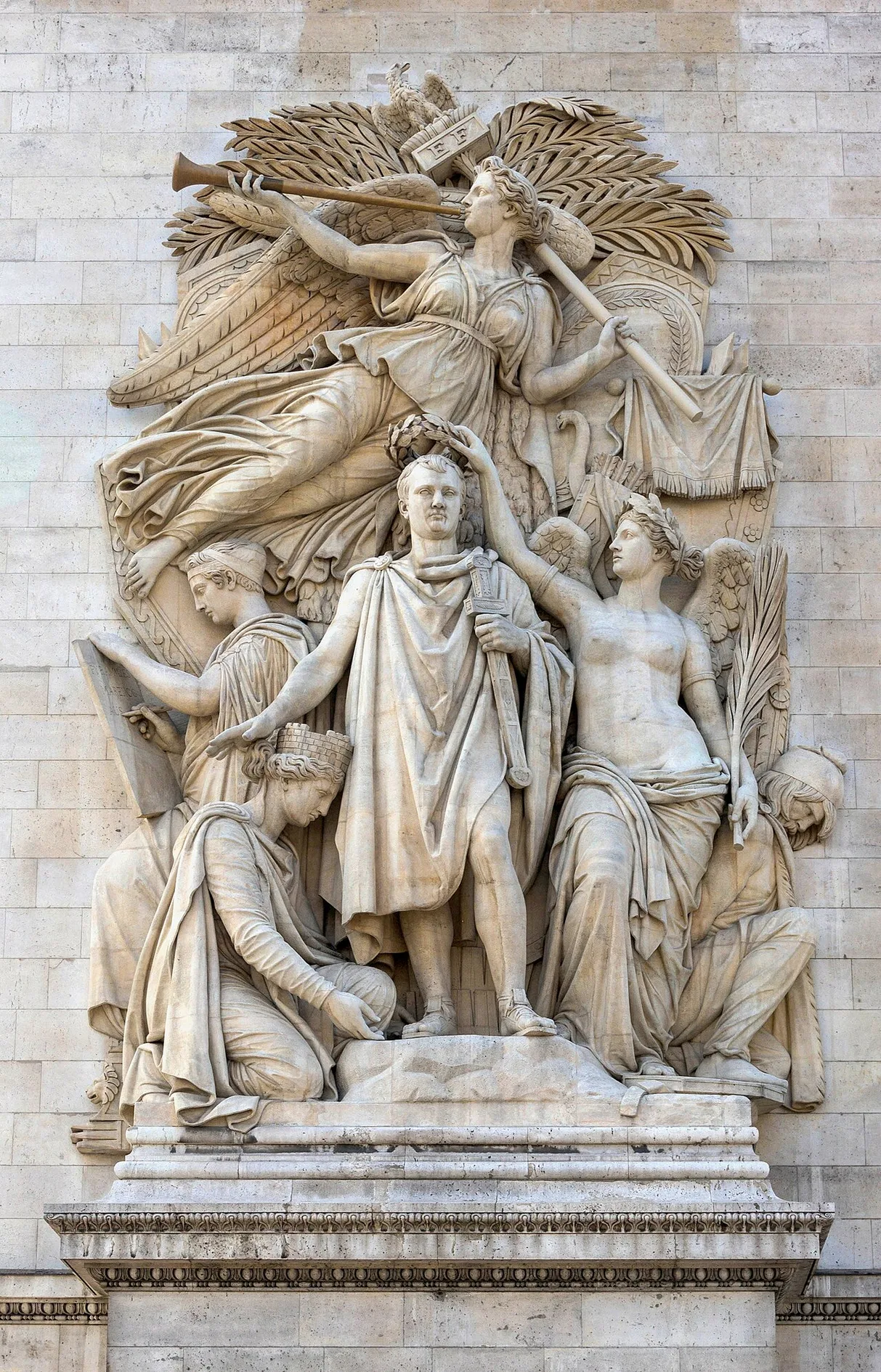
Why it matters: The empire at its widest: 1810 was the year of the conquests and of the marriage to Marie-Louise of Austria that was meant to secure a dynasty. Napoleon stands in antique dress with a sword against him, being crowned by a Victory.
What to notice: Compare the two faces on the same wall and the contrast is the whole point of the building's argument. Rude's group is a crowd in motion. Cortot's is a ceremony holding still. The sculptor David d'Angers said of it that the proportions were flawless but the life was absent, which is harsh and also exactly what you see. Look for the Muse of History behind the kneeling city, carving the emperor's triumphs onto a tablet.
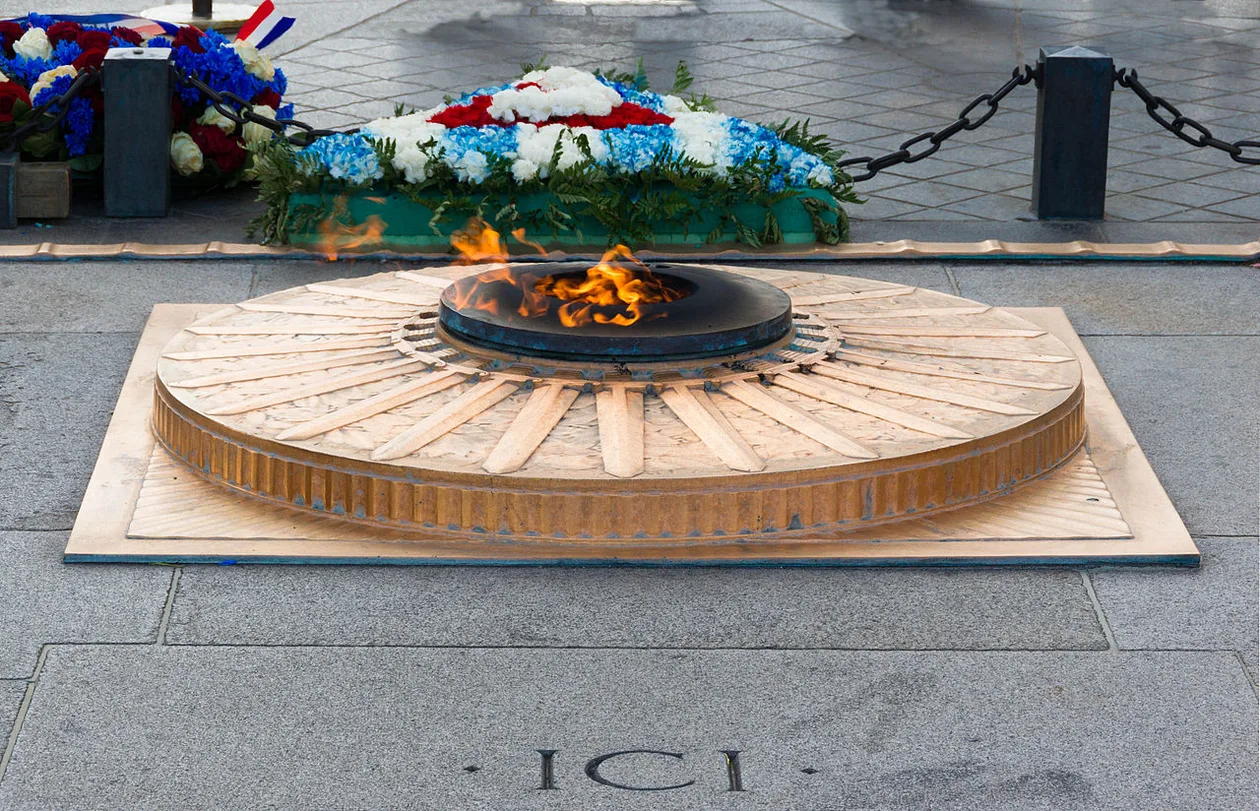
Why it matters: France lost close to 1.4 million men in the First World War and could not agree where to bury the ones it could not name. The Panthéon was proposed and rejected: this was not to be a great man, and the argument was that a secular arch suited an anonymous soldier better than a former church.
What to notice: The flame holder is worth a close look. Edgar Brandt, an ironworker, and the architect Henri Favier built it as a circular shield with a cannon mouth for the flame and twenty-five swords radiating out in a star. Count them. And note what the tomb is not: it is not roped off high on a plinth, it is set flat into the ground you are standing on, which is the whole design decision.
How well did you look?
3 quick questions about what you just saw
Visit complete!
Share your visit or save it for later
Your collection