Six Million Beneath the City
A section-by-section walk through the quarry tunnels, the ossuary doorway, and the bone arrangements most visitors pass without reading.
Get your free guide
Enter your email to unlock the full room-by-room guide. One email unlocks all Paris museum guides.
Free · No spam · Unsubscribe anytime
The route runs one way only, 1.5 km, no turning back. The bones are not décor — they are six million people transferred from Parisian cemeteries between 1787 and 1814. Walk slowly enough to read the walls.
After 131 spiral steps, the first galleries contain no bones — only the original limestone quarry that supplied Paris's medieval construction. The carved walls, chisel marks, and tunnel dimensions document the underground infrastructure the city was built on. Do not rush this section. The information panels here explain why the bones were moved here at all — starting with the collapse of the Saints-Innocents cemetery in 1786 and the public health crisis that followed.
The threshold is marked by a stone arch with the inscription 'Arrête, c'est ici l'empire de la mort' — Stop, this is the empire of death. This is the exact boundary between quarry and ossuary, placed here when the site first opened to the public in 1809. Stop and read it. Visitors who walk straight through miss the fact that someone decided this phrasing, placed it precisely here, and expected it to be read.
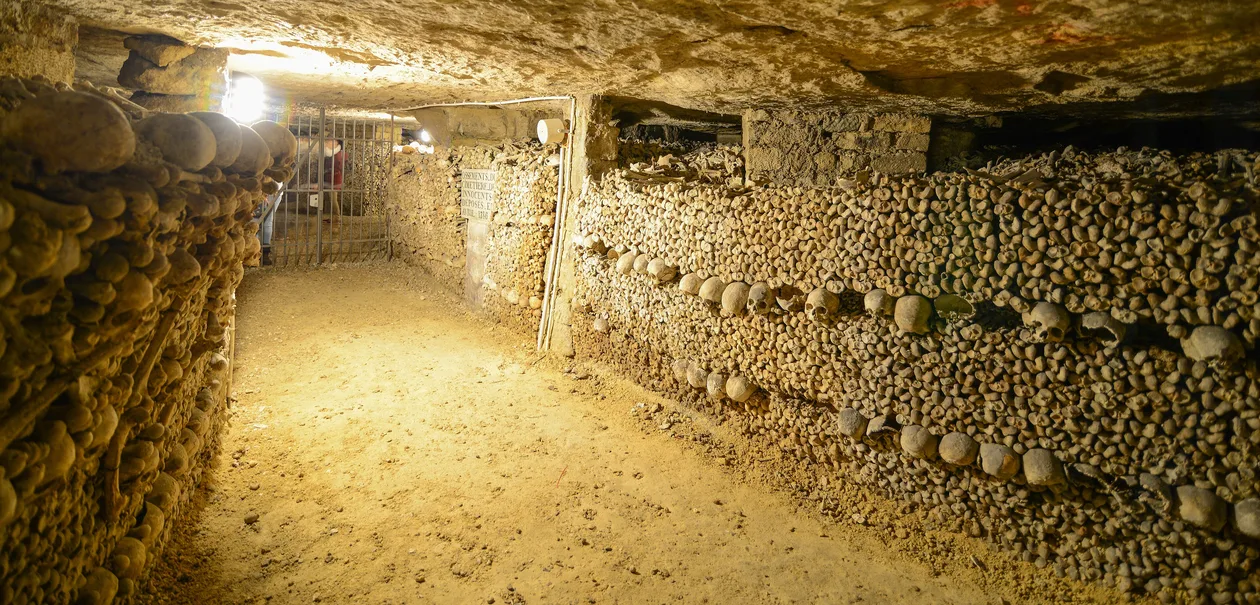
The bone walls extend through the main galleries. Inspector Héricart de Thury organized them 1810–1814: rows of femurs and tibias form the visible face, with remaining bones stacked behind. This is not random accumulation — it is designed arrangement. Midway through, the Port-Mahon corridor holds limestone reliefs carved by quarryman François Décure over several years of lunch breaks. The Fontaine de la Samaritaine, a spring the quarrymen used, appears along the route — easy to miss without the audioguide flagging it. Exit via 112 steps at Avenue René-Coty.
The official site releases tickets exactly 7 days ahead — no earlier. Set a calendar reminder. In summer, morning weekend slots sell out within hours of going live. The last entry slot (19:30) consistently holds availability longer.
14°C underground feels cold after the first 20 minutes. The floor alternates between cement, compacted dirt (muddy after rain), and gravel. If you're over 168 cm / 5'5", you will crouch in some passages. Sandals and heels are mistakes reviewers consistently report.
You enter at 1 Avenue du Colonel Henri Rol-Tanguy (Place Denfert-Rochereau) and exit at 21 bis Avenue René-Coty, several blocks away. No re-entry once you leave. The only toilets are at the entrance and at the exit — none inside the 1.5 km circuit.
The 2026 renovated audioguide is location-automated and covers the main stops well. A live guide adds the quarry history, the political context of the bone transfer, and the section on Décure's sculptures in more depth than the panels. Decide based on whether you want a briefed walking companion or prefer to move at your own pace.

Why it matters: Placed in 1809 when the ossuary first opened to the public, the inscription marks the exact threshold where quarry becomes cemetery. It was not decorative — it was a directive to visitors. The person who wrote it expected it to stop you.
What to notice: The arch is low. You have to slow down to pass under it. This is not accidental — the architecture forces the change in pace. Stand still for a moment before crossing. The air and the light both change within a few steps.

Why it matters: Quarryman François Décure spent years of lunch breaks carving a scale relief of the Port-Mahon fortress in Minorca — the site where he was held prisoner by the British during the Seven Years' War. He carved it underground, in the dark, with quarry tools, into the walls of his workplace. He died before finishing.
What to notice: The carving includes a staircase that descends into the rock — Décure was carving his way deeper, adding rooms to the structure over time. Look at the level of detail relative to the tools he had available. This is not a sketch; it is a reconstruction of memory.

Why it matters: When the bones arrived between 1787 and 1814, they were initially dumped without order. Inspector Héricart de Thury spent four years reorganizing them: femurs and tibias form the visible wall face, skulls are placed at intervals, and the remaining bones are stacked behind. He treated the ossuary as an architectural project.
What to notice: The pattern repeats through multiple galleries but is not identical throughout. In certain sections, hearts and crosses are formed from skulls set into the femur rows. These arrangements were deliberate aesthetic decisions made in the early 19th century about how six million people should be presented to visitors.
How well did you look?
3 quick questions about what you just saw
Visit complete!
Share your visit or save it for later
Your collection