Four Monuments, One Morning
A monument-by-monument route through the Tower climb, the Baptistery, the Cathedral, and the Camposanto — with timing for each stop.
Get your free guide
Enter your email to unlock the full room-by-room guide. One email unlocks all Pisa museum guides.
Free · No spam · Unsubscribe anytime
The Tower is why you come. The Baptistery is why you stay longer than planned.
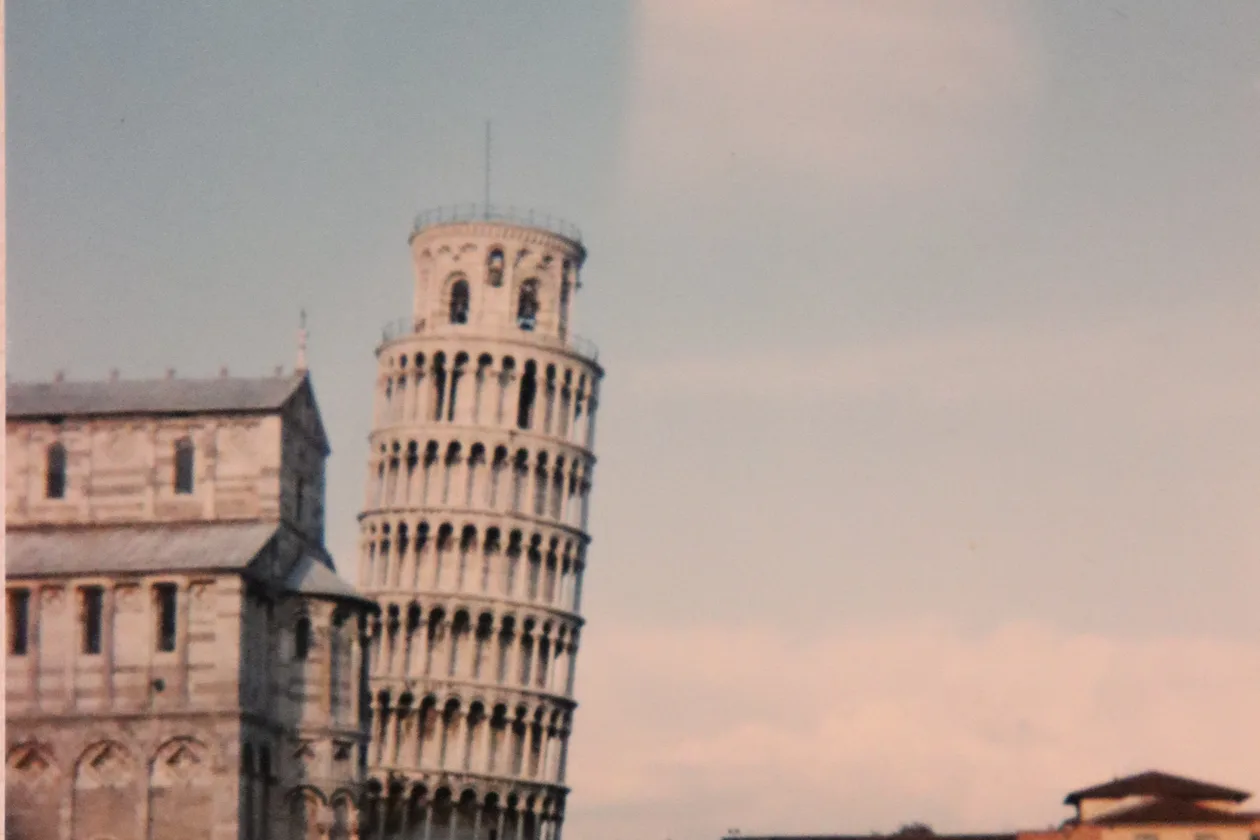
Go directly to the Tower at your booked slot. Deposit your bag at the free cloakroom 15 minutes before entry. The climb is 251 steps on sloping, worn marble — the staircase curves against the lean. Most visitors find the descent harder than the ascent. The view from the top gallery over the Piazza is the payoff: the Baptistery in the foreground, the Cathedral behind, and the city spreading beyond.
Your Tower ticket includes free Cathedral entry — use it. Inside the Cathedral, Giovanni Pisano's marble pulpit (1302–1311) contains eight carved panels of extraordinary density: the Nativity, the Massacre of the Innocents, the Last Judgment. Then cross to the Baptistery. Nicola Pisano's earlier pulpit (1260) is in the centre — his son's work in the Cathedral is a direct response to it. If a custodian demonstrates the acoustics with a sung note, stand near the dome and listen.
The Camposanto is the walled cemetery along the north edge of the Piazza — a long rectangular cloister that most visitors walk past without entering. Inside, on the east wall, is the Triumph of Death fresco attributed to Buonamico Buffalmacco (14th century). It shows a mounted hunting party confronting three open coffins: a king, a bishop, a nobleman, each in stages of decay. It is one of the most direct medieval meditations on mortality in Italy, and the room that contains it is rarely crowded.
The cloakroom deposit takes time. If you are late for your Tower slot, you will not be admitted and you will not be refunded. This is stated explicitly in the ticket conditions and enforced.
All bags — including small handbags and backpacks — must go in the free cloakroom before the climb. Use your ticket as the deposit token. Remember your locker number; you collect your items immediately after.
Any paid Piazza ticket gives you a free Cathedral pass. The Cathedral opens to visitors at 10:00, one hour after the Tower and Baptistery. Plan accordingly — Tower first, Cathedral second.
Nicola Pisano carved the Baptistery pulpit in 1260. His son Giovanni carved the Cathedral pulpit forty years later. Standing in front of each, you can trace the shift from classical restraint to Gothic emotional intensity — two generations of the same workshop, two different answers to the same question.

Why it matters: Nicola Pisano carved this hexagonal marble pulpit in 1260 and changed the direction of Italian sculpture. The narrative panels — Nativity, Adoration of the Magi, Presentation at the Temple, Crucifixion, Last Judgment — draw directly from classical Roman sarcophagi. The figures have weight, volume, and physical presence that Italian art had not seen for centuries.
What to notice: Look at the Nativity panel. The Virgin reclines on a flat slab like a Roman matron on a funerary relief. The Christ child below her is tucked low in the composition, easy to overlook. Pisano is not telling a devotional story — he is solving a sculptural problem, and the solution comes from pagan Rome.

Why it matters: Giovanni Pisano's response to his father's work forty years earlier. The Baptistery pulpit is calm and architectural. The Cathedral pulpit is compressed, agitated, emotionally charged. The figures in the carved panels press against each other, faces turn sharply, grief and movement replace classical stillness.
What to notice: Find the Massacre of the Innocents panel. The bodies of infants and the expressions of mothers are carved with a ferocity that has no parallel in 13th-century Italian sculpture. Giovanni is not translating Roman models — he has left them behind entirely.

Why it matters: Painted before the Black Death arrived in Pisa (1348), this fresco confronts mortality with a directness that is hard to look at neutrally. A hunting party — nobles on horseback, hawks on their wrists — encounters three open coffins containing the bodies of a king, a bishop, and a nobleman in different stages of decay.
What to notice: Follow the gaze of the riders. Some look away, covering their noses. One looks directly at the coffins. In the upper right corner, devils and angels compete for the souls departing the dead. It is not an allegory — it reads as a document, as if someone painted what they expected to see any day.
How well did you look?
3 quick questions about what you just saw
Visit complete!
Share your visit or save it for later
Your collection