Jasper Johns: Night Driver at Guggenheim Bilbao — What to See (2026)
Nearly 140 works, seven decades, the only European stop for one of post-war art's most influential figures. The Guggenheim Bilbao's Jasper Johns retrospective runs until October 12.
Jasper Johns painted his first American flag in 1954, fresh from a dream about painting one. He was in his mid-twenties, walking away from the Abstract Expressionism that ruled New York, and he chose a thing everyone already knew by heart. That decision reshaped American art. The Guggenheim Bilbao has gathered nearly 140 works from across his seven decades — the only European stop for this retrospective — until October 12.
- Nearly 140 works across galleries 201–209: paintings, sculptures, drawings, prints, a stage design
- Flags, targets, numbers, maps from the 1950s through the Catenary series of the 2000s
- Tickets €18, under 18 free, no free Tuesday — runs until October 12, 2026
What is the Jasper Johns retrospective?
The show takes its name from Night Driver, a 1960 drawing Johns identified as his first work grounded in personal feeling. That is the thread the retrospective follows: an artist who built his reputation on cool, impersonal signs, then spent decades pulling private emotion out of them.
Curated by Enrique Juncosa, it runs chronologically from the 1950s flags and targets, through the denser, more melancholic work of the 1960s, to the crosshatch abstractions, the four seasons, and the late Catenary pieces. Paintings and sculptures are hung apart from the works on paper, so each medium reads on its own terms.
Where to book
Our take: Buy the official entry — it includes Johns and an audio guide, and it's €18 for the rest of the run. Johns does reward context, so if the flags and targets look like blank signs to you, the GetYourGuide guided exterior tour (€45, English, 4.7★ from 93 reviews) puts an expert in the room with you — but it covers the museum broadly, not this retrospective, so don't buy it expecting a Johns walkthrough. Either way, finish before October 12.
Get the room-by-room guide
What to look for
The first flag (1954–55). Start here and stand close. Johns built the surface in encaustic — pigment in hot wax — over scraps of newspaper you can still read. The flag is flat and familiar; the surface is anything but. That tension is the whole career in one painting.
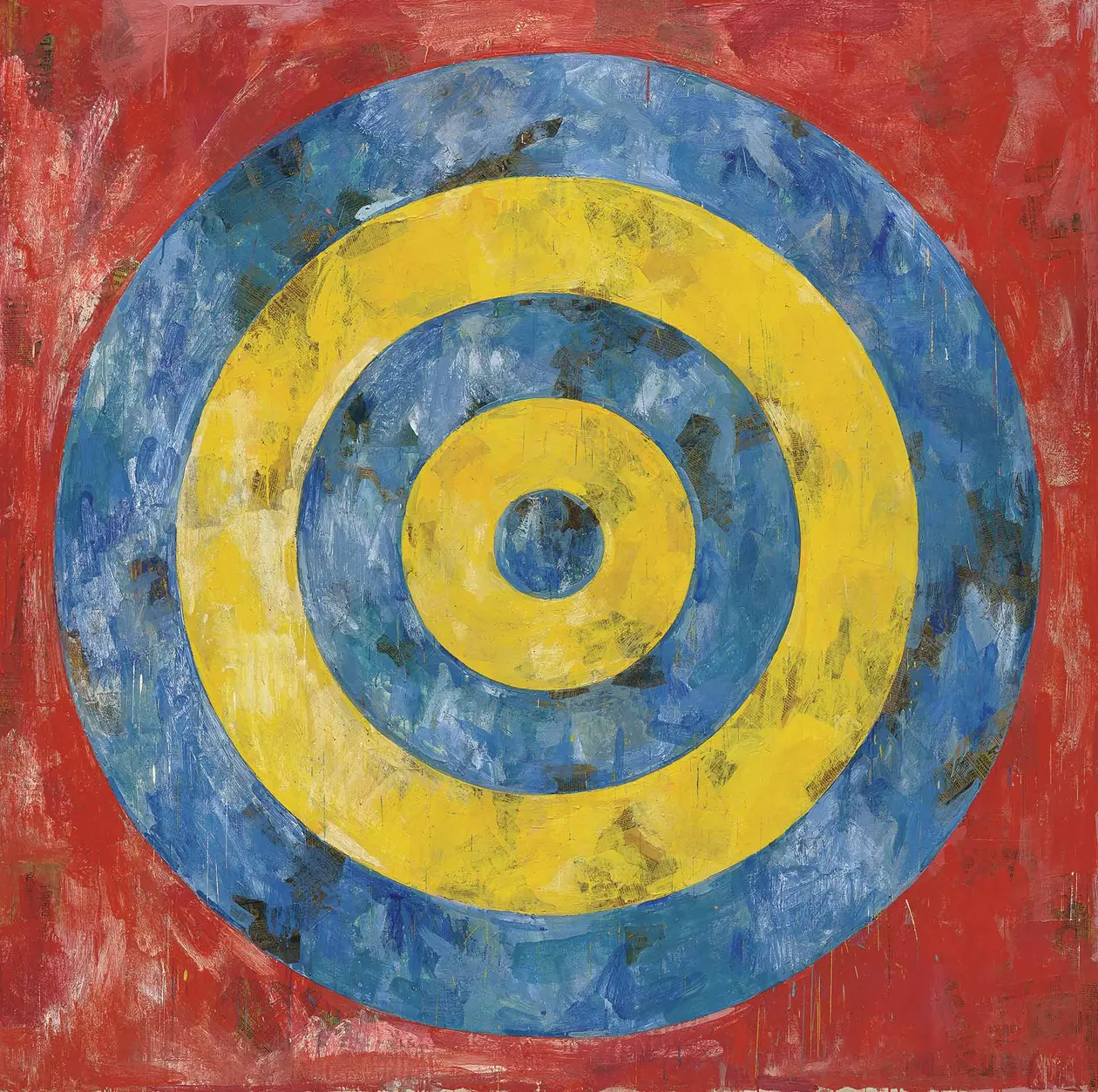
The targets. A target is made to be aimed at. Johns hangs it on a wall and asks you to look instead of aim. Notice how the concentric rings stop being a sign and start being paint.
The numbers and letters. Stencilled, ordinary, repeated. Track how he turns counting and the alphabet — systems with no feeling in them — into surfaces dense with it.
The crosshatch paintings of the 1970s and 80s. Pure intersecting lines, no image at all. After a room of recognisable signs, these read as Johns testing what a painting can be when the familiar object is removed.
The Catenary series (1990s–2000s). A catenary is the curve a hanging string makes under its own weight. Late Johns literally pinned string across the canvas. Look for the actual cord, then the painted echo of it.
What most visitors wish they'd known
Budget more time than a paintings show suggests. The motifs only pay off when you compare them across decades — the same flag, target or number returning changed. Walked past quickly, it looks repetitive. Read slowly, it's the point. A realistic minimum is 90 minutes.
There is no free Tuesday window — don't plan around one. Travel sites and AI assistants widely claim the Guggenheim Bilbao is free on Tuesdays from 6:00 to 8:00 PM. We priced that exact slot on the museum's booking engine in July 2026: €18, the full rate. Our Guggenheim Bilbao tickets guide breaks down every price tier and how to book.
The price didn't drop after the summer. The adult ticket is still €18 into October, and Night Driver closes on 12 October. The last day of a temporary show carries a 50% discount from 4:00 PM, so 12 October afternoon is the cheapest way in.
Pairing it with the Bellas Artes: the Museo de Bellas Artes reopened on 6 October 2026 and now charges €12, free on Tuesdays for its collections. From 14 October a combo ticket covers both museums for €16.
- Exhibition
- Jasper Johns: Night Driver — 29 May to 12 October 2026
- Tickets
- Adults €18 · Students 18–25 / 65+ half price · Under 18 free
- Free admission
- None — no free Tuesday. 50% off from 4:00 PM on 12 Oct (last day)
- Hours
- Tue–Sun 10:00–19:00 (until 20:00 in summer, 15 June–13 September)
- Location
- Guggenheim Museum Bilbao, Abandoibarra Etorbidea 2, Bilbao · Galleries 201–209
- Website
- guggenheim-bilbao.eus
Hours and admission details can change — confirm on the official page before you go.
Last verified: June 2026
Frequently asked questions
Is the Jasper Johns exhibition included in the Guggenheim Bilbao ticket?
Yes. The regular adult ticket includes Jasper Johns: Night Driver and all other exhibitions, with no per-show surcharge. The adult ticket stays at €18 for the rest of the show's run, which closes on 12 October (checked on the museum's booking engine on 1 October 2026). The price drops to €12 from 13 October, once the show has closed. Under 18 enter free. There is no free Tuesday evening window, despite what most travel sites say.
When does the Jasper Johns retrospective at Guggenheim Bilbao close?
The exhibition runs from May 29 to October 12, 2026. It is the only European stop for this retrospective.
How long does the Jasper Johns exhibition take?
Most visitors spend 1.5 to 2 hours across nearly 140 works in galleries 201–209. Allow more time if you want to read the recurring motifs across decades rather than walk past them.
Who was Jasper Johns?
Jasper Johns (born 1930) is an American artist who broke from Abstract Expressionism in the mid-1950s with paintings of flags, targets, numbers and maps. He is regarded as a pivotal figure behind Pop Art, Minimalism and Conceptual Art.
The Guggenheim Bilbao rarely hosts a retrospective this complete. If you're in the Basque Country before October, go.
Already subscribed? Open the room-by-room guide →