How Long Do You Need at the Uffizi Gallery? (2026 Guide)
Plan about 2 hours for a highlights visit — Botticelli, Leonardo, Michelangelo, Caravaggio — and 3 hours if you want the full Renaissance sweep. The Uffizi holds around 100 rooms; nobody walks all of them. Here's how long to spend by visitor type, plus 2h and half-day routes.
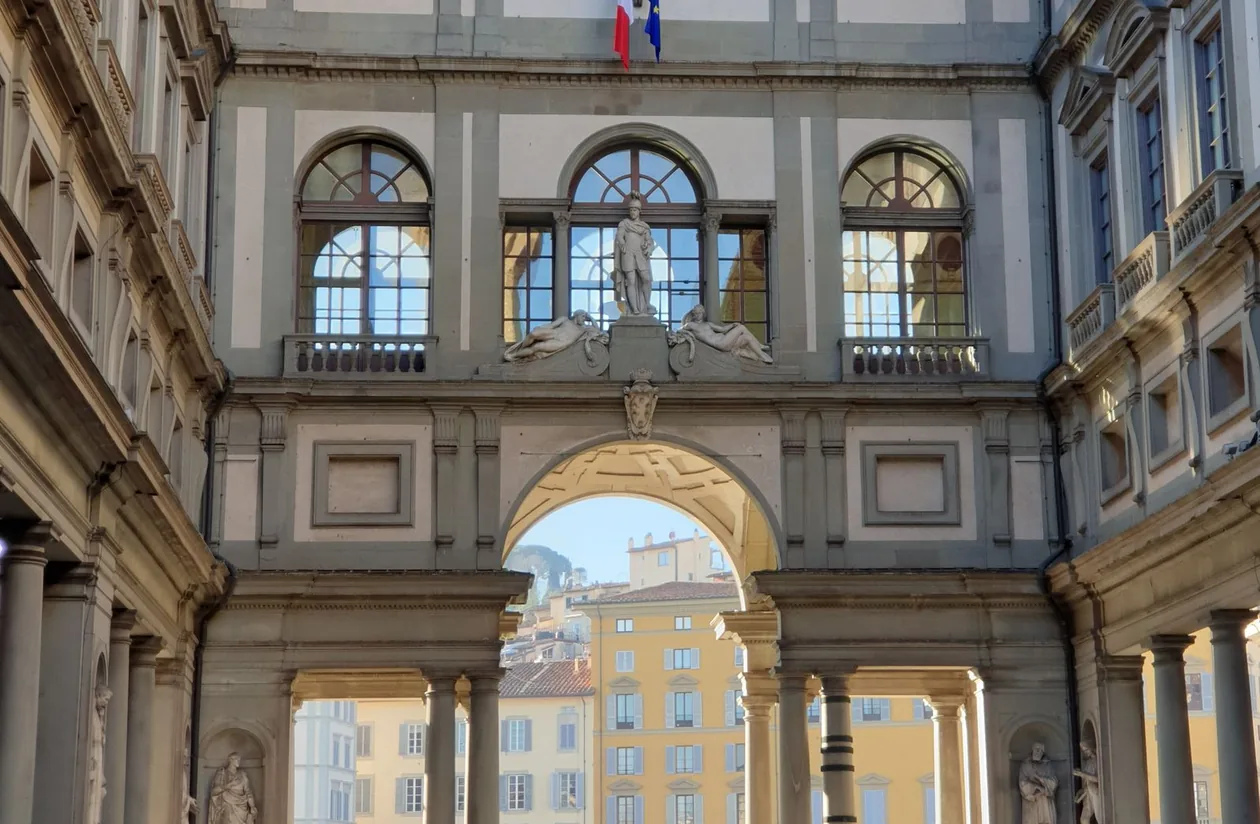
Plan on about 2 hours for a highlights visit — Botticelli, Leonardo, Michelangelo, and Caravaggio — and 3 hours if you want the full Renaissance sweep with time to sit with the paintings. Art lovers who want most of the rooms should block 3 to 4 hours. Seeing everything is not a real option: the Uffizi runs around 100 rooms, and nobody walks all of them in a single visit.
Most people overestimate one thing and underestimate another. They think they need half a day (they don't — 2 focused hours covers the famous rooms), and they forget that the queue outside can eat more time than the art inside. So "how long at the Uffizi" is really two questions: how long you spend with the paintings, and how long you spend getting to them.
This is a timing and routing guide. For prices and ticket tiers, see our Uffizi tickets guide; for the quietest hours, see best time to visit the Uffizi.
How long to spend at the Uffizi by visitor type
Express visit — about 1.5 hours. The direct route and nothing else. Straight up to the second floor for Botticelli's Birth of Venus and Primavera (rooms 10–14), Leonardo's Annunciation, Michelangelo's Doni Tondo, then down to Caravaggio's Medusa and Bacchus on the first floor on the way out. No early Gothic rooms, no map room, no lingering. This is the "we have one Florence day and the Uffizi is one stop" plan.
Highlights visit — about 2 hours. The realistic sweet spot for a first visit, and the number most reviewers land on. Same core route, but at a pace that lets you actually stop: a proper few minutes with the Birth of Venus, the Leonardos, the Titian Venus of Urbino, and the Caravaggios, plus a walk down the great east corridor with its ancient sculpture and the view over the Arno to Ponte Vecchio. You leave having seen the Uffizi, not just marched through it.
In-depth visit — 3 to 4 hours. For people who came for the painting. The full highlights route, plus the earlier rooms — Giotto and Cimabue, the international Gothic, the Piero della Francesca portraits — and the later halls with Rubens, the self-portrait collection, and the Niobe room. Break it with a coffee at the rooftop café above the loggia; the rooms blur after three hours of gold ground and fresco, and the Uffizi has more of both than almost anywhere.
Full day / two visits — 5+ hours. Only for serious enthusiasts, and usually split across two entries or paired with the Vasari Corridor. The Uffizi rewards a focused 2-to-3-hour visit far more than an open-to-close marathon; the crowds and the sheer density of masterpieces wear most people down before the collection does.
The Uffizi guide — your 2-hour route through the Renaissance
- The room-by-room path that runs Botticelli → Leonardo → Michelangelo → Caravaggio without backtracking
- Exact room numbers and how long to give each stop — and what to walk straight past
- Where the Birth of Venus crowd forms and the quiet minute to catch it from
If you only have X hours at the Uffizi
If you have 90 minutes: Take the 8:15 opening slot, go straight up to the second floor, and start at the Botticelli rooms (10–14) before the tour groups arrive around 9:00. Then Leonardo's Annunciation, Michelangelo's Doni Tondo, the Titian Venus of Urbino, and down to the Caravaggios on the first floor. Skip the early Gothic rooms and the long secondary corridors. Ninety minutes is a real visit if you keep moving and don't try to read every label.
If you have 2 hours: Same core route, more stopping. Add the east corridor walk with its sculpture and the Ponte Vecchio view, and give the Birth of Venus the few quiet minutes it deserves before the crowd builds. This is the complete first-visit version — the one most people should aim for.
If you have a half-day: Do the 2-hour highlights route while the museum is quietest, then double back for the earlier rooms — Giotto, Piero della Francesca, the Gothic panels — and the later halls. Break it with a coffee on the rooftop terrace. If you booked the Vasari Corridor, add roughly an hour for the walk over the Arno to Pitti.
Why the queue matters more than the rooms
The paintings take about 2 hours. The queue can take longer than that. Without a booking, the on-site line runs 2 to 3 hours from April to September and 3 to 4 hours on the free first Sunday of the month — in full sun, on Piazzale degli Uffizi, with no shade and no shortcut. That's the single biggest variable in how long your Uffizi day takes, and it's the one you fully control.
That's why timing matters as much as duration. A 2-hour visit at the 8:15 opening feels calm and complete; the same 2 hours starting at 11:00 is mostly shuffling shoulder-to-shoulder through rooms 10–14 waiting for a gap in front of the Botticellis. The paintings don't change — the crowd does. If you can, take the first slot of the day. For the full breakdown of quiet windows, see best time to visit the Uffizi.
Booking the visit for the time you have
The queue is the real time cost, and a pre-booked timed ticket is the skip-the-line system — there's no separate "fast track" to buy. A standard ticket is €25 online (plus the €4 booking fee) or €21 at the window with no fee; entry after 4 PM drops to €16 and still leaves 2.5 hours until last entry at 5:30 PM. The first two morning slots (8:15–8:30 and 8:30–8:45) carry a €19 early-bird price. Book direct at tickets.uffizi.it for the lowest price; the 8:15 slots sell out weeks ahead in high season.
If the official checkout is sold out or acting up (it often is), GetYourGuide's skip-the-line Uffizi ticket with audio guide (4.2★, 5.8K reviews) adds a digital audio guide, free cancellation up to 24 hours before, and independent allocations — usually the only realistic way to lock an early slot when the official site shows sold out. Its price moves with demand: close to official in quiet months, a good deal more in high season. Check the listing and decide whether the working checkout and the quiet hour are worth that day's gap.
The honest answer
If someone gives you a number with no context, ignore it. The right length depends on how deep you want to go: 90 minutes to walk the highlights, 2 hours to actually take them in, 3 to 4 hours to add the earlier rooms and the self-portraits, and a full day only if the Uffizi is the reason you came to Florence. What ruins the visit isn't spending too little time inside — it's spending 2 hours outside in the queue because you didn't book a slot, then fighting the crowd for a view of the Birth of Venus because you didn't take the early one.
How long at the Uffizi — at a glance
- Express visit
- ~1.5 hours · second-floor highlights + Caravaggio only
- Highlights visit
- ~2 hours · the core route at a normal pace (most first-timers)
- In-depth visit
- 3–4 hours · highlights + the earlier Gothic rooms and later halls
- Birth of Venus
- 10–15 min to see · rooms 10–14, the museum's busiest spot
- Best entry time
- 8:15 opening slot · reach the Botticelli rooms before ~9:00
- Queue without a booking
- 2–3 hours in summer, 3–4 on the free first Sunday · near-zero with a timed ticket
- Opening hours
- Tue–Sun 8:15 AM–6:30 PM, last entry 5:30 PM · closed Mondays
- Ticket price
- €25 online (€21 window) · €16 after 4 PM · €19 first two morning slots
- Book at
- tickets.uffizi.it · €25 · GetYourGuide · skip-the-line + audio · demand-priced · 4.2★
Hours and prices can change — confirm on the official site before you go.
Last verified: July 2026
Frequently asked questions
Can you see the Uffizi in 2 hours?
Yes — 2 hours is the standard highlights visit, and it's enough if you follow a route instead of wandering. The essentials sit on the second floor: Botticelli's Birth of Venus and Primavera (rooms 10–14), Leonardo's Annunciation, Michelangelo's Doni Tondo, and the Renaissance portraits, then Caravaggio's Medusa and Bacchus on the first floor on your way out. What you give up in 2 hours is the long stretch of secondary rooms — the early Gothic panels, the map room, the sculpture corridors — that most visitors walk through without stopping anyway. Move with purpose and 2 hours covers everything people actually come for.
How long to see Botticelli's Birth of Venus?
The painting itself takes about 10 to 15 minutes — but getting a clear view is the real time cost. The Birth of Venus and the Primavera share rooms 10–14, the single busiest spot in the museum, and by mid-morning a wall of phones stands between you and the canvas. Arrive at the 8:15 opening and you can stand in front of both for a few quiet minutes before the tour groups reach the second floor around 9:00. Later in the day, budget an extra 10 minutes just to work your way to the front.
Is one visit enough for the Uffizi?
For almost everyone, yes. One visit of 2 to 3 hours covers the Renaissance highlights the Uffizi is famous for, and most people leave satisfied rather than wishing for a second trip. The museum runs around 100 rooms, so "seeing it all" isn't the goal and isn't realistic in an afternoon — even art historians pick a focus. Only serious enthusiasts who want the full painting collection, the Vasari Corridor, and the drawings and prints cabinet need to come back. One well-planned visit is the norm.
How long is the line at the Uffizi?
With a pre-booked timed ticket, expect 5 to 15 minutes at the priority entrance during the morning. Without a booking, the on-site queue runs 2 to 3 hours from April to September, and 3 to 4 hours on the free first Sunday of the month. That queue is the single biggest time sink of the visit and it's entirely avoidable — every online ticket includes a timed entry slot, which is the skip-the-line system — €25 plus the €4 fee on the official site, or a demand-priced equivalent on GetYourGuide. Book a slot and the line stops being part of your day.
Ready to book? Lock the 8:15 slot on GetYourGuide Uffizi skip-the-line + audio (4.2★, 5.8K reviews) — skip-the-line, free cancellation. Wondering which hour is calmest? Read best time to visit the Uffizi. Still choosing between the Uffizi and the Accademia? See Uffizi vs Accademia — which to pick.
Already subscribed? Open the room-by-room guide →