Tàpies at Museu Tàpies: The Perpetual Movement of the Wall — What to See and Why It Matters
The Museu Tàpies reconstructs four of Tàpies' solo exhibitions from the 1950s — not just the paintings, but the walls, lighting, and furniture. A guide to what to look for in Barcelona's most misunderstood museum.

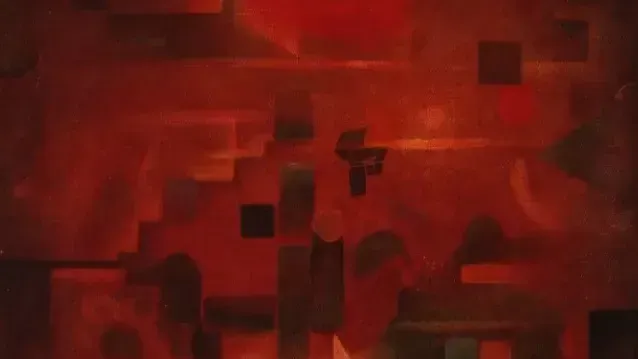
Most visitors walk into the Museu Tàpies expecting something recognisable — a portrait, a landscape, a scene. Instead, they find thick, scarred surfaces made of sand, marble dust, and everyday objects pressed into paint. Many leave in ten minutes. That's a mistake.
This exhibition asks a question most museums don't bother with: how does the way art is displayed change what you actually see? Curators Imma Prieto and Pablo Allepuz have reconstructed four of Tàpies' solo shows from the 1950s — not just the paintings, but the walls, the lighting, even the furniture that shared the room. It's an exhibition of exhibitions.
In 3 Minutes
- How Tàpies transitioned from surrealist painting to "matter art" — and what the 1950s meant for that shift
- What the four reconstructed exhibitions reveal about how display changes meaning
- The 1880s Modernista publishing house and its role in the artistic conversation
What Makes This Exhibition Different
Antoni Tàpies (1923–2012) is the third essential figure in Catalan modern art, alongside Picasso and Miró. Unlike those two, Tàpies stayed in Barcelona. His work is rooted in the city's streets, walls, and material culture.
In the 1950s, he moved from surrealist-influenced work to "matter painting" — thick, textured surfaces built with sand, marble dust, earth, and found objects. The cracked walls of post-war Barcelona were his reference. Over the decade, his canvases grew larger, heavier, more physical. He represented Spain at the Venice Biennale in 1952, 1954, and 1958.
This exhibition traces that evolution through four solo shows Tàpies staged between 1950 and 1960 — in Barcelona and Paris — each with different works, different walls, different display strategies. The curators partially reconstruct each one, so you can feel the difference yourself. As co-curator Pablo Allepuz puts it: "Factors considered anecdotal — the colour of exhibition surfaces, lighting choices — actually comprise a whole structure of mediation that affects how we see Tàpies' legacy today."
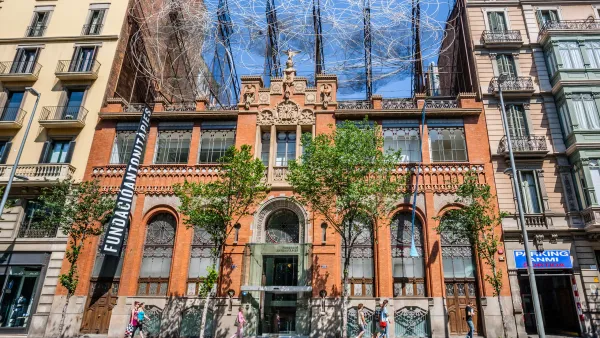
The building matters too. Domènech i Montaner's 1880s publishing house was the Eixample's first exposed-brick-and-iron structure. Its walls echo what Tàpies puts on canvas. On the roof: Núvol i cadira (Cloud and Chair, 1990), a wire chair emerging from clouds.
"It feels as if I'm still experiencing the day of my first opening. I see the dark gallery after crossing the bookshop, where I often said hello to Salvat-Papasseit's widow, who worked there. Some friends came along, and the buyer of the only picture sold in the whole exhibition was the old father of my friends the Samaranchs. But above all I remember my secret love came with her family."
— Antoni Tàpies, Memòria personal, 1977
What to Look For
1. Watch for the display, not just the art. Paintings hung by cables from the ceiling, tilted forward, on coloured walls. Each room reconstructs a different 1950s show. The way you see the work is part of the work.
2. Track how materials evolve. The early rooms still have colour and recognisable figures. By the end, the canvases are thick, scarred, wall-like surfaces made with construction materials. You can see the full arc in one visit.
3. Read the building's walls. The exposed brick and iron of Montaner's 1880s structure mirror what Tàpies puts on canvas. The venue isn't neutral — it participates.
Verified Facts
| Exhibition | Antoni Tàpies: The Perpetual Movement of the Wall |
| Dates | February 12 – September 6, 2026 |
| Curators | Imma Prieto (director) and Pablo Allepuz (head of collections) |
| Works | 50+ from Museo Reina Sofía, MACBA, Fundació "la Caixa", Fundación Juan March, Museu Carmen Thyssen Barcelona |
| Hours | Tue–Sat 10:00–19:00 · Sun 10:00–15:00 · Closed Mondays |
| Price | €12 general · €8 reduced (students, 65+) |
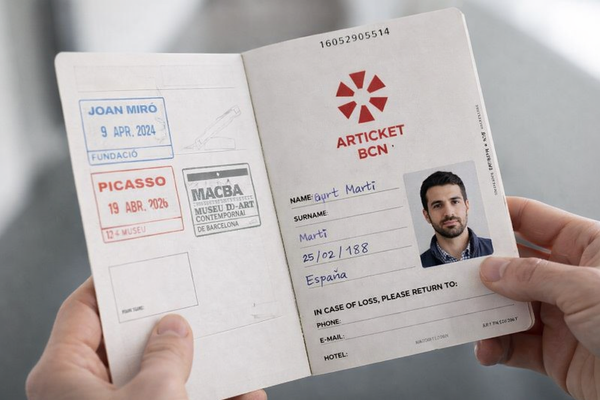
| Articket | €38 (6 museums, skip-the-line) |
| Free days | Feb 12 (Santa Eulàlia), May 18 (Museum Day), Sep 24 (La Mercè) |
| Address | Carrer d'Aragó 255, Barcelona |
| Metro | Passeig de Gràcia (L2, L3, L4) |
| Free visits | Last Sunday of month, 12:30 PM (Approximations guided tour) |
| Leaflet | Free at museum — texts by Cirici i Pellicer, Tharrats, Michel Tapié |
| Also showing | Àngel Jové: De intactu |
| Website | museutapies.org |
Hours and prices can change — confirm on the official site before you go.