MNAC Romanesque Collection: 800 Years of Rescued Murals
Murals rescued from abandoned Pyrenean churches between 1919 and 1923. Here's what to look for, what most visitors miss, and how to plan your visit to the MNAC.

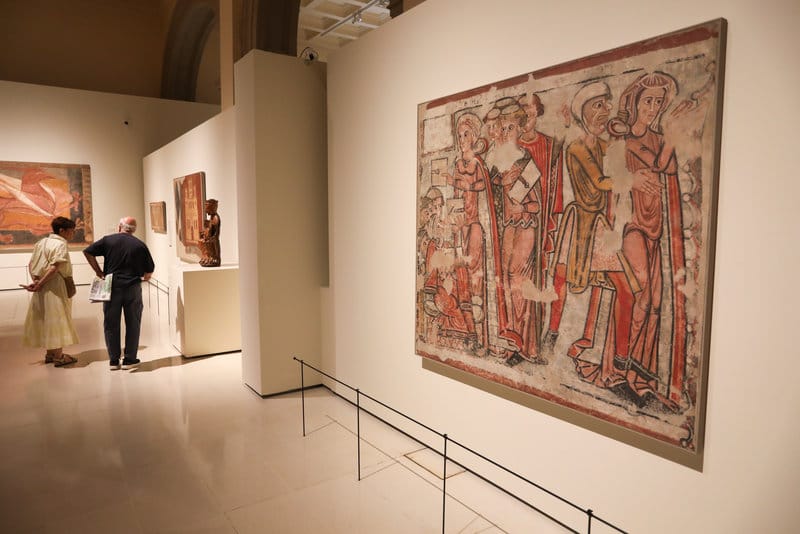
The MNAC Romanesque Collection is considered the finest in the world. These murals were rescued from abandoned Pyrenean churches between 1919 and 1923, brought to Barcelona, and mounted on replicas of the original apses.
If you understand what you're looking at, these 800-year-old paintings feel urgent, not ancient.
In 3 minutes
- Murals made to teach faith to people who couldn't read — rescued before American dealers shipped them abroad
- Mounted on replicas of the original apses, in dark rooms that protect the pigments. The effect is strange and powerful
- Picasso visited in 1934 and called it "an invaluable lesson for the moderns"
Context
In 1919, an American dealer bought frescoes from Santa Maria de Mur and shipped them to Boston. That alarmed the Catalan Board of Museums. They hired Italian restorers who knew strappo — a technique to remove only the painted layer — and rescued dozens of murals from churches across the Pyrenees.
The murals now sit inside the Palau Nacional on Montjuïc. The rooms are dark to protect the pigments. The effect is strange and powerful: medieval teaching tools displayed as fine art.
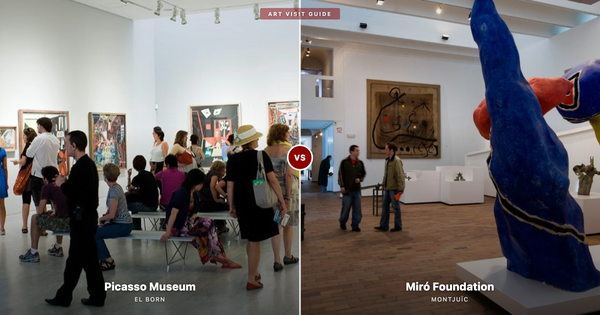
Picasso visited in 1934 and called it "an invaluable lesson for the moderns." The frontality, the geometry, the flat colour — it all reappears in twentieth-century art.
What to look for
- Notice the eyes. The Pantocrator from Sant Climent de Taüll follows you across the room. This was intentional — God sees everything. Stand in the centre and move side to side.
- Read the symbols. Alpha and Omega. Crowns for the wise, none for the foolish. Books, keys, flames. Medieval viewers understood instantly. You can learn to read them in minutes.
- Feel the scale. These weren't made for museums. They filled entire apses in dark stone churches. Stand close, then step back. The shift in perspective is the point.
- Compare the styles. Early works show French influence. Later ones show Italian. The collection is arranged to make this visible — look for the difference between rooms 5 and 7.
- Don't skip the sculptures. The Batlló Majesty is a crucifix without suffering — Christ triumphant, eyes open, looking up. It changed how Spain depicted Christ for centuries.
Tips most sites won't tell you
- Free every Saturday from 3 pm. Also free the first Sunday of every month, all day. Saturday afternoons are quieter than free Sundays — go then if you can.
- The Romanesque section is the highlight, not the whole museum. MNAC is enormous. If you only have an hour, go straight to the Romanesque rooms and skip the rest. You'll see the best of what makes this museum unique.
- Take the escalators from Plaça Espanya. Metro L1/L3 to Espanya, then outdoor escalators up the hill. Much easier than walking. The entrance is at the top.
- Combine it with Miró. The Fundació Joan Miró is a 10-minute walk away on Montjuïc. Start with Miró after lunch, then MNAC for the free Saturday slot from 3 pm. Two world-class museums in one afternoon.
- The rooftop terrace is free and worth the detour. Panoramic views of Barcelona from Sagrada Família to the sea. Access is separate from the museum — ask at reception.
Practical info
Hours and prices can change. Confirm on the official site before you go.
Most people come to MNAC for the building or the views. The ones who find the Romanesque rooms leave with something they didn't expect — 800-year-old paintings that feel more alive than most contemporary art.